Inverse Lithography Technology (ILT)
Inverse lithography technology (ILT) is a computational technique that starts from the pattern wanted on the wafer and works backward to the photomask shape that reproduces it best. Normal simulation predicts the print from a given mask; ILT solves the inverse problem, deriving the mask through mathematical optimisation.
Also called: ILT, inverse lithography, curvilinear OPC
Diagram
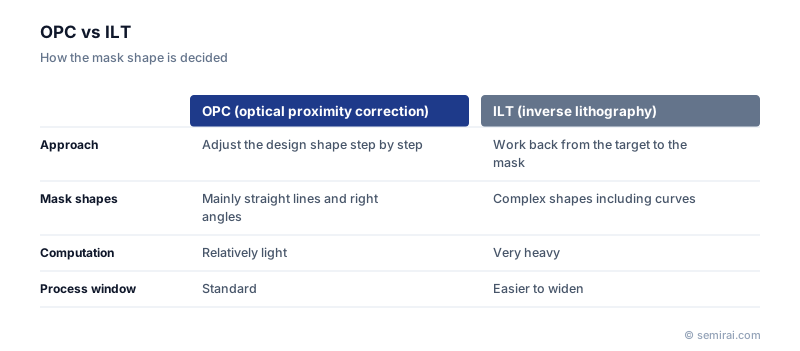
ILT vs OPC
When fine patterns are printed with light, diffraction and interference mean the mask shape is not copied faithfully to the wafer. Optical proximity correction (OPC) compensates by moving pattern edges in small steps and adding small assist features, following rules or models to adjust the original layout.
ILT instead treats the mask shape as free and searches for the optimum. The result is usually a complex, curvilinear mask. Such masks can widen the process window, the range of focus and dose over which the pattern prints within specification.
Why ILT is spreading
The optimisation needs enormous computation, so for a long time ILT was limited to a few critical layers or hotspots. Faster computing, including GPUs, and multi-beam mask writers that can write curved shapes in reasonable time have allowed it to be applied more widely.
ILT is also combined with source-mask optimisation (SMO), which optimises the shape of the illumination together with the mask pattern.
Japanese companies involved
- NuFlare Technology makes multi-beam electron-beam mask writers, the type of tool needed to write the curvilinear masks that ILT produces.
- NuFlare Technology · Electron-beam mask writers, mask inspection and epitaxial reactors
FAQ
Why do ILT masks have curved shapes?
The optimiser is not restricted to straight edges and right angles, and the physics of diffraction and interference favours smooth, rounded features. The mask shape that prints the target best therefore contains curves. Variable-shaped-beam writers struggle with such shapes, while multi-beam writers handle them without a large time penalty.
Does ILT replace OPC entirely?
Not usually. Fabs often use full ILT for the hardest layers or regions and conventional model-based OPC elsewhere, balancing pattern quality against computation time and mask cost. The two can share the same lithography models, so mixed flows are common.
Related pages
Sources
Last updated: November 13, 2026