Metal Oxide Resist (MOR)
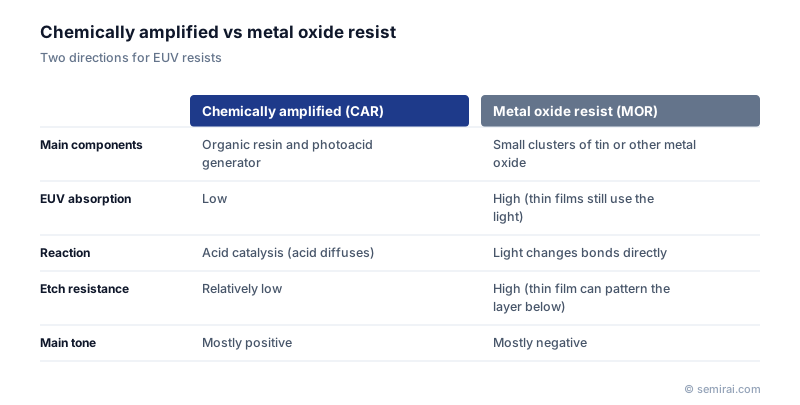
Metal oxide resist (MOR) is a type of photoresist for EUV lithography whose main component is an oxide of a metal such as tin. It consists of metal-oxygen clusters a few nanometres across, surrounded by organic ligands. EUV exposure strips the ligands, the oxide clusters link up and the film becomes insoluble, so most MORs work as negative resists.
Also called: MOR, metal-oxide photoresist, inorganic EUV resist
Diagram
Why metal oxides suit EUV
EUV light at 13.5 nm is weakly absorbed by conventional organic resists made of carbon and hydrogen. Each EUV photon carries a lot of energy, so for a given dose there are relatively few of them, and random variation in their number causes roughness and defects, the so-called stochastic effects. Tin and similar metals absorb EUV much more strongly, so even a thin film uses the light efficiently.
Metal oxides also resist etching well. The film can therefore be made thinner and still transfer the pattern to the layer below, and thinner lines are less likely to collapse.
Wet and dry approaches
The best-known developer of spin-on MOR is Inpria of the United States, now part of JSR. Separately, Lam Research has developed a dry resist that is deposited from gas-phase precursors in a vacuum chamber and also developed in the gas phase.
In high-NA EUV, the depth of focus is shallower and resist films must be thinner, which increases interest in metal-based resists. Bringing metals into tools and fabs, however, makes contamination control an important issue.
Japanese companies involved
- JSR owns Inpria, a developer of tin-oxide-based spin-on metal oxide resists for EUV.
- Tokyo Ohka Kogyo (TOK) is a major supplier of EUV photoresists, the field in which metal oxide resists compete with chemically amplified ones.
- JSR · Photoresists and semiconductor materials
- Tokyo Ohka Kogyo (TOK) · Photoresists and high-purity process chemicals
FAQ
How does MOR differ from a chemically amplified resist?
A chemically amplified resist is an organic polymer in which photo-generated acid catalyses reactions, so the image spreads by acid diffusion. A metal oxide resist is built from small inorganic clusters whose bonds change directly under EUV. Higher absorption and the absence of acid diffusion are its claimed advantages for fine patterns.
What is a dry resist?
A resist that is deposited from gas-phase precursors inside a vacuum tool instead of being spin-coated, and is developed in the gas phase as well. Lam Research has developed one. Thickness can be made thin and uniform, and with no liquid developer, capillary forces that cause pattern collapse are avoided.
Comparisons
Related pages
Sources
Last updated: November 12, 2026