NA (Numerical Aperture)
NA (numerical aperture) is a dimensionless measure of the range of angles over which an optical system can collect or deliver light, defined as NA = n × sinθ, where n is the refractive index of the medium and θ the maximum half-angle. In lithography it is one of the two optical quantities, with wavelength, that set resolution.
Also called: numerical aperture
Diagram
Resolution and depth of focus
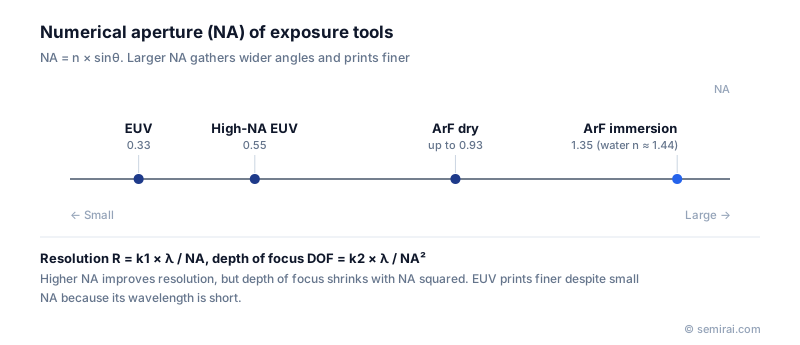
A pattern is imaged by capturing the light it diffracts. Finer patterns diffract light to wider angles, so a lens with higher NA can capture the diffraction orders of smaller features. This is expressed in the Rayleigh relation R = k₁ × λ / NA.
The price is depth of focus, which scales as DOF = k₂ × λ / NA². Raising NA makes the image sharp over a thinner slice, so wafer flatness, resist thickness and focus control all become tighter. This is why planarisation by chemical mechanical polishing (CMP) matters so much for lithography.
NA values in real tools
In air, sinθ cannot exceed 1, so dry lithography lenses stop below NA 1; dry ArF scanners reached about 0.93. Filling the gap between lens and wafer with water (n ≈ 1.44 at 193 nm) raises the limit, and ArF immersion scanners reach NA 1.35.
EUV tools use mirrors in vacuum, so n = 1. Standard EUV scanners have NA 0.33 and High-NA EUV tools 0.55. These look small next to immersion, but the 13.5 nm wavelength is so short that even NA 0.33 resolves far finer lines than ArF immersion. Reaching 0.55 required anamorphic optics that reduce the image 4x in one direction and 8x in the other.
Japanese companies involved
- Nikon and Canon design and manufacture their own projection lenses for their scanners and steppers, one of the few places outside Germany where lithography optics of this class are made.
FAQ
Why does higher NA give finer patterns?
Higher NA lets the lens collect light diffracted at wider angles, and fine patterns diffract light at wide angles. Capturing more diffraction orders reproduces smaller features.
What is the downside of high NA?
Depth of focus shrinks with the square of NA, so small variations in wafer height or resist thickness push the image out of focus. Larger lenses or mirrors also raise cost and make aberration control harder.
How can immersion lithography exceed NA 1?
Because n in NA = n × sinθ is the refractive index of the medium. Air has n close to 1, but water has n ≈ 1.44 at 193 nm, so the same angle gives a larger NA, up to 1.35 in practice.
Related pages
Sources
Last updated: November 2, 2026