Internal Thermal Oxidation (ITOX)
ITOX (internal thermal oxidation) is a technique in which an SOI wafer made by the SIMOX method is heated above 1,300 °C in an oxygen-rich atmosphere, so that the buried oxide (BOX) grows from the inside, becoming thicker and better in quality. It was developed in Japan as an improvement to SIMOX.
Also called: ITOX, ITOX-SIMOX
Diagram
The problem ITOX solves
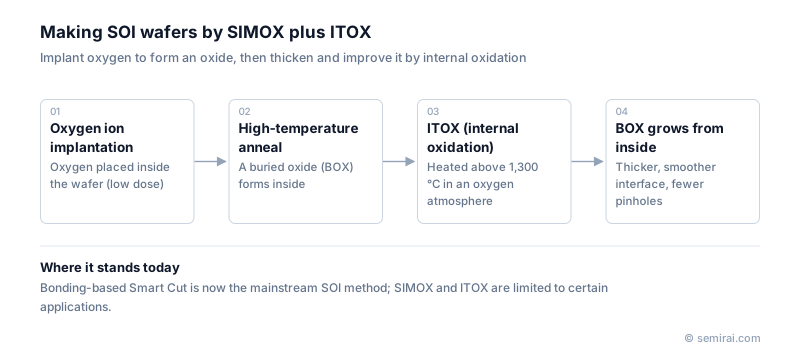
SIMOX (separation by implanted oxygen) makes SOI by implanting a large dose of oxygen ions into a silicon wafer and annealing it at high temperature so that an oxide layer forms inside. A high oxygen dose leaves crystal damage in the top silicon. Reducing the dose (low-dose SIMOX) gives a better crystal, but the buried oxide becomes thin and tends to keep defects such as pinholes.
In ITOX, oxygen from the atmosphere diffuses through the top silicon layer and reacts at the interface between the buried oxide and the silicon. The oxide therefore grows from the inside. As it thickens, the interfaces become smoother and pinholes are closed, which made it possible to produce high-quality SOI from low-dose SIMOX.
Where ITOX stands today
The mainstream method for SOI wafers is now bonding-based Smart Cut, which controls layer thickness precisely and lets the donor wafer be reused. SIMOX and ITOX are limited to certain applications.
One design point is that ITOX also oxidises the surface, which consumes part of the top silicon. The final silicon layer thickness has to be planned with this loss in mind.
Japanese companies involved
- ITOX was developed by Japanese researchers in the 1990s, and Japanese crystal growth research has continued work on improving SIMOX wafer quality.
- SUMCO · Silicon wafers
FAQ
What is SIMOX?
SIMOX forms SOI from a single wafer by implanting a high dose of oxygen ions and annealing at high temperature to create a buried oxide. It needs no bonding, but too much oxygen leaves crystal defects and too little gives a thin, defect-prone oxide.
Why does ITOX thicken the buried oxide?
At high temperature in an oxygen atmosphere, oxygen diffuses through the top silicon and reacts at the buried oxide interface, forming new oxide there. Growth from the inside thickens the layer, smooths the interface and seals pinholes.
Related pages
Sources
Last updated: November 2, 2026