Magnetic Czochralski Method (MCZ)
The MCZ method (magnetic-field-applied Czochralski method) grows a single silicon crystal by the Czochralski (CZ) method while a strong external magnetic field is applied to the melt in the crucible. The field suppresses convection in the electrically conductive melt, which reduces and stabilises the oxygen taken into the crystal. It was developed in Japan around 1980.
Also called: MCZ, magnetic-field-applied Czochralski, HMCZ
Diagram
How the magnetic field helps
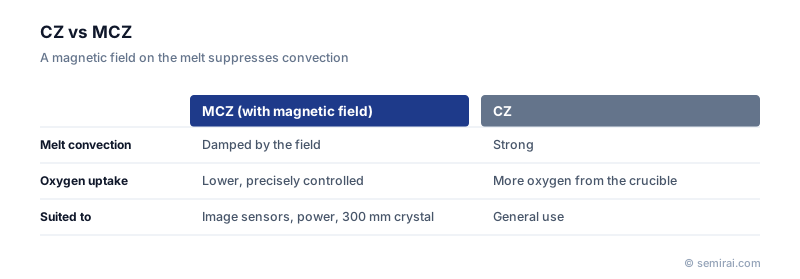
In CZ growth, silicon is melted in a quartz crucible, and temperature differences drive strong convection in the melt. This convection carries oxygen dissolved from the crucible into the crystal. It also makes the melt temperature fluctuate, leaving striped variations in oxygen and dopant concentration called growth striations.
Molten silicon conducts electricity. When a magnetic field is applied, the melt moving across the field lines feels a force opposing its motion, so convection is damped. This lets the grower reduce the oxygen in the crystal or hold it precisely at a target level, and reduces striations. The field can be applied horizontally, or as a cusp field formed by two coils with opposite field directions above and below the melt.
Where MCZ crystal is used
Low and uniform oxygen matters in image sensors, where oxygen-related defects cause dark current and white spots. In power devices such as IGBTs, oxygen can shift electrical characteristics, so float-zone (FZ) silicon, which contains almost no oxygen, has traditionally been used. MCZ crystal, which is available in larger diameters at lower cost, is increasingly replacing it.
For 300 mm crystals, the large volume of melt makes convection stronger, and MCZ has become essential for stable crystal quality.
Japanese companies involved
- Shin-Etsu Chemical and SUMCO grow MCZ silicon crystals for 300 mm wafers and for low-oxygen applications such as image sensors and power devices.
- Shin-Etsu Chemical · Silicon wafers, photoresists and photomask blanks
- SUMCO · Silicon wafers
FAQ
Why not simply use FZ silicon for all low-oxygen needs?
FZ crystal is grown without a crucible, so it has very little oxygen, but it is limited to smaller diameters and costs more. MCZ offers controllably low oxygen on large-diameter crystals using the established CZ infrastructure.
Does lower oxygen have any downside?
Yes. Oxygen in CZ silicon strengthens the wafer against slip and forms precipitates that getter metal contamination. Very low-oxygen wafers lose some of these benefits, so the oxygen level is chosen to match the device and process.
Comparisons
Related pages
- Czochralski Process (CZ Method)
- Interstitial Oxygen (Oi)
- Silicon Ingot
- Float Zone Process (FZ Method)
- IGBT (Insulated Gate Bipolar Transistor)
- CMOS Image Sensor (CIS)
- Swirl Defect
- Crystal growth furnaces
- Daiichi Kiden Round-Chamber Crystal Puller (CZ Method)
- Daiichi Kiden S278 / S380
- Ferrotec FT-CZ1200SE/1400SE
Sources
Last updated: November 13, 2026