Minor Stoppage
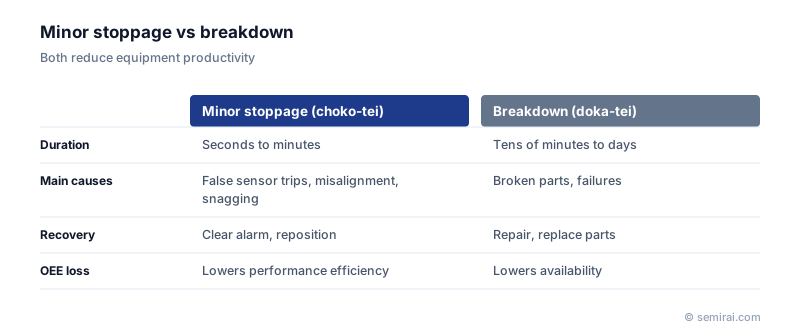
A minor stoppage is a short stop of production equipment, lasting from a few seconds to a few minutes, caused by a small problem rather than a breakdown. Typical causes are false sensor detections, slight wafer misalignment, waiting for transport and parts catching. An operator clears the alarm or corrects the position and the tool runs again at once.
Also called: choko-tei, short stop, idling and minor stoppage
Diagram
Why minor stoppages matter
Each stop is short and needs no repair, so it often goes unrecorded. But if it happens dozens of times a day, the total lost time becomes large and steadily cuts the tool's output.
In overall equipment effectiveness (OEE), minor stoppages and reduced speed count as losses in performance efficiency. Together with long breakdown stops, which reduce availability, they are a key target for improvement.
How fabs reduce them
The first step is accurate records of when, where and how often a tool stops. Semiconductor tools report alarms and state changes automatically through SECS/GEM, the communication standard between equipment and factory systems, so stop counts and durations can be totalled without manual logs.
Engineers then work through the most frequent causes: adjusting sensors, replacing worn parts and fixing software. Data on the patterns that precede a stop also feeds predictive maintenance, so problems are addressed before the tool halts.
Japanese companies involved
- The Japanese factory term choko-tei, meaning a brief stop, comes from total productive maintenance (TPM) practice, which developed in Japanese manufacturing and treats minor stoppages as a distinct loss.
- Yokogawa Electric supplies fab software for equipment communication and MES, which is used to collect stop data from tools.
- Yokogawa Electric · Fab software: MES, equipment communication and cell control
FAQ
How does a minor stoppage differ from a breakdown?
A minor stoppage lasts seconds to minutes, is caused by a small problem and is cleared by an operator without repair. A breakdown, sometimes called doka-tei in Japanese factories, is a long stop due to a failure such as a broken part and needs repair. In OEE, breakdowns reduce availability and minor stoppages reduce performance efficiency.
Why are minor stoppages often underestimated?
Because each one is so short, operators fix it and move on without logging it, and shift reports show only the long stops. Only automatic collection of alarms and state changes reveals how much time they add up to, which is why data comes before countermeasures.
Related pages
Sources
Last updated: November 13, 2026