PFC Gas Emissions
PFC gases are perfluorocarbons, compounds of only carbon and fluorine such as carbon tetrafluoride (CF4) and hexafluoroethane (C2F6). In the semiconductor industry the term often also covers nitrogen trifluoride (NF3) and sulphur hexafluoride (SF6). These gases are used in large amounts for dry etching and for cleaning CVD chambers, and they are powerful greenhouse gases.
Also called: perfluorocarbons, fluorinated greenhouse gases, F-gases
Diagram
Why PFCs matter
Per unit of mass, these gases trap thousands to more than 20,000 times as much heat as carbon dioxide, and they break down very slowly; CF4 is estimated to persist in the atmosphere for tens of thousands of years. The plasma in a tool does not decompose all of the gas, so part of what is used leaves in the exhaust unchanged.
For a chip fab, these process gases make up a large part of its direct (Scope 1) greenhouse-gas emissions.
How emissions are reduced
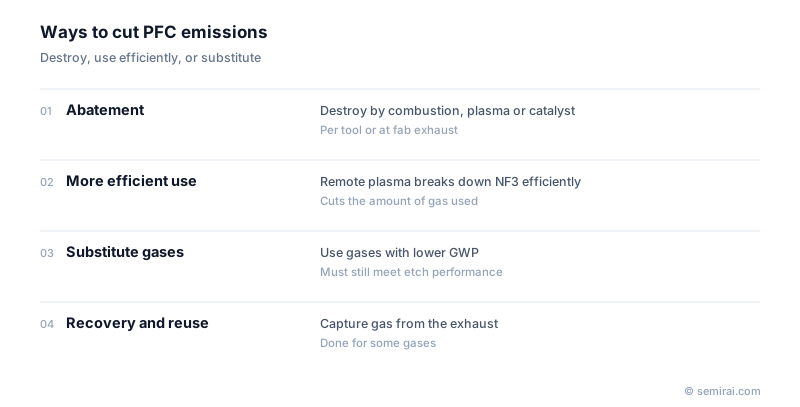
There are three main approaches. The first is abatement: destroying the gases in the exhaust by combustion, plasma or catalysts. The second is using less gas, for example cleaning CVD chambers with a remote plasma source that breaks NF3 down efficiently outside the chamber and sends in only fluorine radicals. The third is switching to substitute gases with a lower global warming potential, which must still give acceptable etch performance.
The global semiconductor industry has set voluntary reduction targets since the 1990s, and PFC reduction now features in individual companies' decarbonisation goals.
Japanese companies involved
- Ebara and Kanken Techno make exhaust gas abatement systems that destroy PFCs and other process gases in fab exhaust.
- Kanto Denka Kogyo produces fluorine-based specialty gases used in etching and chamber cleaning.
- Ebara · CMP systems, dry vacuum pumps and exhaust treatment
- Kanken Techno · Exhaust gas abatement systems (scrubbers)
- Kanto Denka Kogyo · Fluorine-based specialty gases
FAQ
Where are PFC gases used in chipmaking?
Mainly in two places. In dry etching, fluorinated gases etch oxide, nitride and other films. In CVD chamber cleaning, gases such as NF3 remove film that builds up on the chamber walls. In both cases the plasma frees fluorine, which reacts with the material being removed.
Are PFC gases the same as PFAS?
They are usually treated as different issues. PFC gases are regulated mainly as greenhouse gases. PFAS are persistent fluorinated chemicals whose regulation is driven by concerns about the environment and health. Depending on how PFAS is defined, however, some fluorinated gases may fall inside the definition.
Related pages
- Abatement System (Scrubber)
- Specialty Gas
- Plasma Etching
- PFAS Regulation
- CVD (Chemical Vapour Deposition)
- Nitrogen Trifluoride (NF3)
- Sulfur Hexafluoride (SF6)
- Carbon Tetrafluoride (CF4)
- Specialty gases
- Ebara TND-Single (including TND-Single Plus)
- Kanken Techno KT1000 series
- Daikin Industries HFC-32
- Daikin Industries PFC-14
Sources
Last updated: November 12, 2026