SECS/GEM
SECS/GEM is a family of SEMI communication standards that lets semiconductor manufacturing equipment exchange data and commands with the factory host computer, such as the manufacturing execution system (MES). Because every maker follows the same standards, any tool can be connected to factory systems in the same way, which made fab automation possible.
Also called: SECS-II, GEM, HSMS, SEMI E5, SEMI E30
Diagram
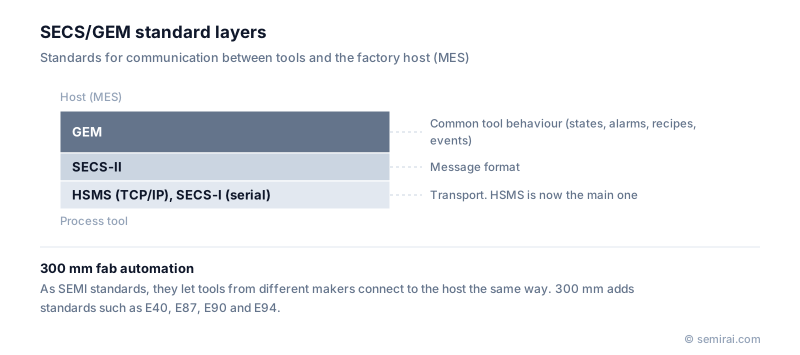
The layers
SECS-I (SEMI E4) sends messages over an RS-232 serial line. HSMS (SEMI E37) sends the same messages over TCP/IP networks at much higher speed and is now the main transport. SECS-II (SEMI E5) defines the message format and meaning, grouping messages by stream and function numbers.
GEM (Generic Equipment Model, SEMI E30) defines behaviour that every tool should share: control and processing states, event reports, alarms, remote commands, and recipe management. With GEM, a host can start and stop processing, select recipes and collect data from different tools using the same logic. The standards are also used outside semiconductors, for example in flat panel display and solar cell equipment.
300 mm extensions and data collection
Full automation of 300 mm fabs added a set of standards often called GEM300, including E40 (process jobs), E87 (carrier management), E90 (substrate tracking) and E94 (control jobs). They cover FOUP hand-off and the tracking of each wafer through the tool.
For collecting large volumes of sensor data for advanced process control and predictive maintenance, fabs also use the separate Equipment Data Acquisition (EDA, Interface A) standards. SEMI E172 (SEDD) describes a tool's data in a machine-readable file, which speeds up setting up the SECS/GEM connection.
Japanese companies involved
- Japanese equipment makers such as Tokyo Electron supply their tools with SECS/GEM and GEM300 interfaces so they can be connected to fab host systems.
- Tokyo Electron (TEL) · Coat/develop, etch and deposition equipment
- Yokogawa Electric · Fab software: MES, equipment communication and cell control
FAQ
What is the difference between SECS/GEM and HSMS?
SECS/GEM is the umbrella name for the standards. HSMS (SEMI E37) is the part that defines how messages travel over TCP/IP networks. It replaced the older serial SECS-I link in most fabs.
What does GEM define?
GEM, the Generic Equipment Model in SEMI E30, defines the common behaviour of equipment as seen by the host: states, events, alarms, remote commands, recipe handling and data collection. A GEM-compliant tool can be integrated with standard host software.
Related pages
Sources
Last updated: November 1, 2026