Particle Contamination
Particle contamination is the deposition of tiny particles on the wafer surface that cause defects in the finished chip, and the field of controlling it. A particle about half the size of the smallest feature can bridge two lines or block a pattern, so a single particle can kill a die. Particle control is one of the basic activities that determine fab yield.
Also called: particle control, particulate contamination, defect particles
Diagram
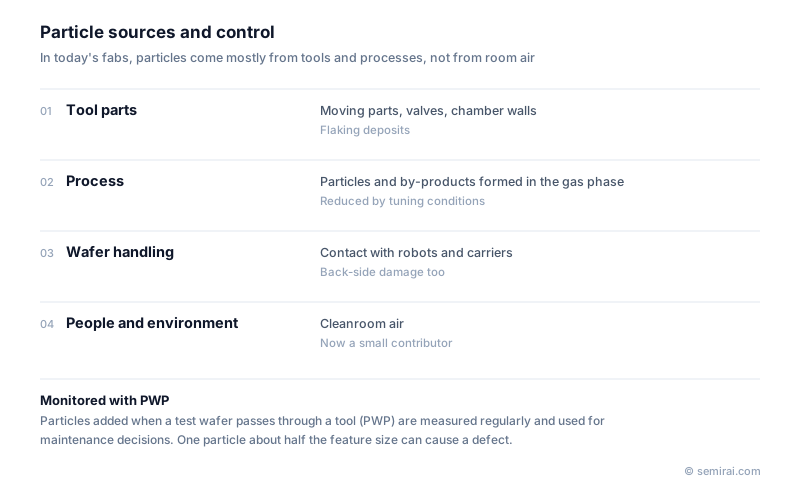
Where particles come from
Sources fall into three groups. The environment contributes particles from cleanroom air, people and materials brought into the fab. Equipment generates them through wear of moving parts, flaking of deposits from chamber walls, erosion of consumable parts by plasma, and valves and pumps. Processes create them through gas-phase reactions that form powder, agglomerates in chemicals and residual abrasive from CMP slurry.
Modern cleanrooms and closed wafer transport have made the air very clean, so in today's fabs equipment and processes are the dominant sources, not the room. A particle on the wafer back side can matter too: it can tilt the wafer during lithography and cause focus errors.
Prevent, keep out, remove
Control follows three principles: do not generate particles, do not let them reach the wafer, and remove those that land. Wafers travel in sealed FOUPs and are opened only inside equipment front-end modules (EFEMs) with filtered air, cutting them off from the room. Inside chambers, plasma-resistant coatings, low-particle parts, careful seasoning and controlled pumping and venting reduce generation.
Particles that do land are removed in cleaning steps such as single-wafer spray cleaning, brush scrubbing and two-fluid spray cleaning. As patterns shrink this gets harder: small particles stick relatively more strongly, and the force needed to remove them can damage fragile structures, so prevention upstream comes first.
Detecting and monitoring particles
Unpatterned wafer surface inspection tools scan a laser across the wafer and detect the light scattered by particles, giving a count, a size distribution and a map. Fabs measure each tool's particle adders by running clean monitor wafers through it and counting the particles added per wafer pass (PWP). A tool that exceeds its limit is taken down for cleaning or preventive maintenance. The shape of the particle map, such as a ring, an edge cluster or a scratch-like line, often points to the part of the tool that is responsible.
Japanese companies involved
- SCREEN Holdings makes wafer cleaning equipment used to remove particles between process steps.
- TOCALO applies thermal spray coatings to equipment parts and refurbishes them, which reduces particles generated by plasma erosion of chamber components.
- Shin-Etsu Polymer makes FOUPs and other wafer carriers that keep wafers sealed during transport.
- Shin-Etsu Polymer · FOUPs, FOSBs and reticle pods
- SCREEN Holdings · Wafer cleaning, coat/develop and inspection equipment
- TOCALO · Thermal spray coatings and refurbishment of equipment parts
FAQ
What is PWP?
PWP stands for particles per wafer pass: the number of particles added to a clean monitor wafer when it passes through a tool or chamber. Fabs track it on a schedule for every tool, so a rising trend can trigger maintenance before product wafers are affected.
How small a particle matters?
A common rule of thumb is that a particle about half the critical dimension of a layer can cause a fatal defect on that layer. As features shrink, the killer particle size shrinks with them, and inspection tools must detect ever smaller particles.
Why do chamber parts generate particles?
Films deposit on chamber walls and parts during every run and eventually crack or flake, and plasma slowly erodes ceramic and quartz parts. Coatings, regular cleaning, part replacement and conditioning wafer runs after maintenance all aim to control this.
Related pages
Sources
Fab infrastructure and equipment parts terms
Last updated: November 2, 2026