Throughput
Throughput is the amount a tool or factory can process in a given time. For front-end equipment it is stated as wafers per hour (WPH); back-end assembly and test tools use units per hour (UPH). Since tools are very expensive, throughput directly sets the equipment cost of each wafer.
Also called: WPH, wafers per hour, UPH
Diagram
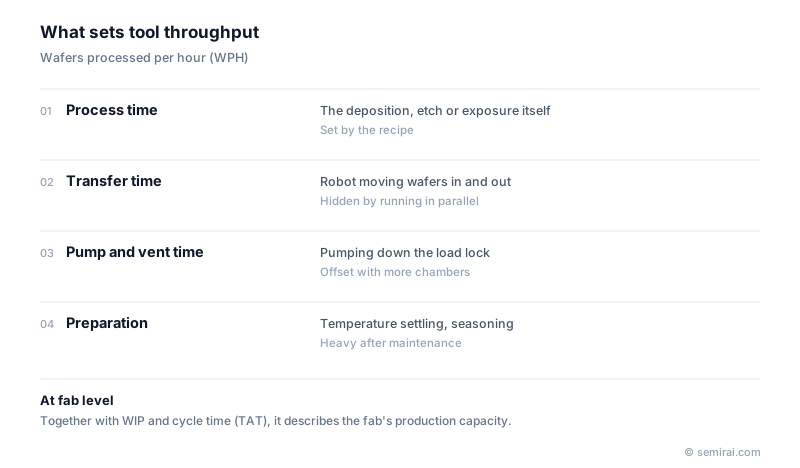
What sets tool throughput
The process time itself is only part of the picture. Pumping and venting the load lock, robot transfers, wafer alignment and waiting for temperature to settle all add overhead. In a cluster tool with several chambers, the slowest step becomes the bottleneck for the whole tool. In lithography, stage speed and light source power dominate; in etch and deposition, process time usually does.
Tool makers raise throughput by running chambers in parallel, hiding transfers behind processing and shortening pump-down. The catalogue figure is measured under ideal conditions, so fabs plan with an effective throughput that accounts for set-ups, maintenance and waiting.
Throughput at fab level
For a whole fab, throughput is the number of wafers finished in a period. It is tied to work in process (WIP) and cycle time by Little's law: WIP = throughput × cycle time. If throughput is fixed by the bottleneck tools, adding more WIP does not produce more wafers; it only makes lots wait longer.
Production planning therefore starts by finding the bottleneck tool group and its real capacity, then setting wafer starts and buying tools so that the bottleneck stays busy without long queues.
Japanese companies involved
- Tokyo Electron and other Japanese equipment makers compete on wafers per hour as well as process results, through multi-chamber designs and faster wafer handling.
- Daifuku supplies automated transport systems whose delivery speed affects how much of a tool's throughput a fab can actually use.
- Tokyo Electron (TEL) · Coat/develop, etch and deposition equipment
- Daifuku · Cleanroom automated material handling systems (AMHS)
FAQ
What does 200 WPH mean?
It means the tool can process 200 wafers in one hour under the stated conditions, for example a given exposure dose for a scanner. Real output is lower once idle time, maintenance and qualification runs are included.
How can throughput be increased?
On a tool: shorten non-process time by faster transfers, parallel chambers and shorter pump-down. In a fab: identify the bottleneck step and add tools there or raise their availability; improving non-bottleneck tools does little for total output.
Related pages
Sources
Last updated: November 1, 2026