Oil Diffusion Pump
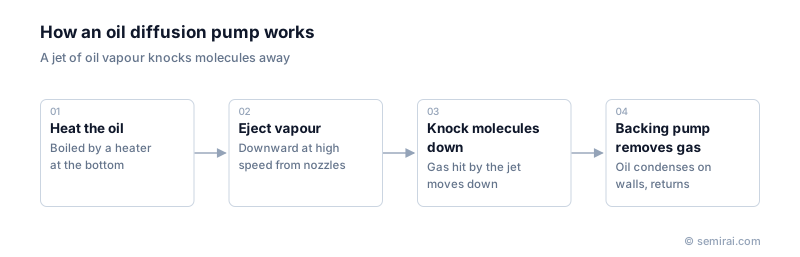
An oil diffusion pump is a high-vacuum pump that heats a special oil until it boils, then sends the vapour downwards at high speed through nozzles. Gas molecules that enter the jet are knocked downwards and removed. It has no moving parts, is simple and robust, and gives high pumping speed at low cost.
Also called: diffusion pump, DP
Diagram
How it works
A diffusion pump cannot start from atmospheric pressure. A backing pump such as a rotary pump is connected to its outlet and first lowers the pressure.
Gas pushed down by the vapour jet is removed by the backing pump. The oil vapour condenses on the cooled pump wall, runs back to the boiler at the bottom and is heated again, so the oil circulates continuously.
Because there are no bearings or rotors, a diffusion pump runs quietly, without vibration, and can last for many years with little more than periodic oil changes. Its drawbacks are the time needed to heat up and cool down and the risk of oil contamination.
Backstreaming and where the pump is used today
The main weakness is backstreaming: oil vapour travelling back towards the chamber. Even a trace of oil contaminates surfaces. Cooled traps and baffles reduce it but cannot stop it completely.
Semiconductor process tools, which need very clean vacuum, have therefore switched to turbomolecular pumps and cryopumps. Diffusion pumps are still used in coating systems with large vacuum vessels, vacuum heat-treatment furnaces and research equipment.
Japanese companies involved
- ULVAC makes oil diffusion pumps alongside turbomolecular pumps and other high-vacuum pumps.
- ULVAC · Vacuum deposition (sputtering) equipment and vacuum pumps
FAQ
How does a diffusion pump differ from a turbomolecular pump?
A diffusion pump knocks molecules away with a jet of oil vapour; a turbomolecular pump does it with fast-spinning blades. Both need a backing pump. Turbomolecular pumps use no oil in the pumping path and start and stop quickly, while diffusion pumps are cheaper and have no moving parts to wear.
What is backstreaming?
Backstreaming is oil vapour or its breakdown products flowing from the pump back into the chamber, against the pumping direction. It leaves a thin oil film on substrates and parts, weakening film adhesion and causing contamination. Cooled traps and baffles reduce it but do not remove it entirely.
Related pages
Sources
Last updated: November 1, 2026