Molecular Flow and Viscous Flow
Molecular flow and viscous flow are the two regimes of gas flow in vacuum pipes and chambers. In viscous flow, at relatively high pressure, molecules collide with each other constantly and move together like a fluid. In molecular flow, at low pressure, molecules hardly meet and each one flies on its own, bouncing off the walls. The range between them is called transitional flow.
Also called: viscous flow, molecular flow, transitional flow, Knudsen number
Diagram
What decides the regime
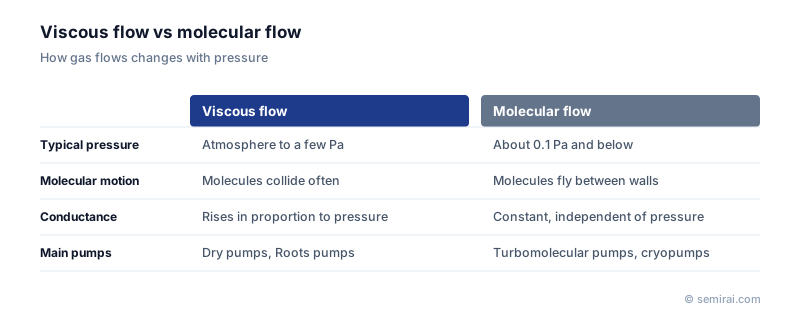
The regime depends on the ratio of the molecules' mean free path to the pipe diameter, known as the Knudsen number. In pipes of ordinary size, flow from atmospheric pressure down to roughly a few pascals is viscous, and below about 0.1 Pa it is molecular.
In viscous flow, the conductance of a pipe (how easily gas passes through it) rises in proportion to pressure. In molecular flow, conductance no longer depends on pressure and is set only by the pipe's diameter and length.
What it means for vacuum design
The first stage of pumping from atmosphere is viscous flow, and dry pumps can move large volumes of gas quickly. In high vacuum the flow becomes molecular, and pumping relies on molecules happening to fly into the pump inlet. Turbomolecular pumps are therefore mounted directly on the chamber through wide, short connections to keep conductance high. Long, narrow pipes greatly reduce pumping speed in the molecular regime.
Japanese companies involved
- ULVAC makes vacuum pumps and vacuum process equipment, whose design depends on these flow regimes.
- ULVAC · Vacuum deposition (sputtering) equipment and vacuum pumps
FAQ
At what pressure does viscous flow become molecular flow?
It depends on pipe size. For pipes a few centimetres across, flow is roughly viscous above a few pascals, molecular below about 0.1 Pa and transitional in between. Strictly, it is judged by the Knudsen number, and narrower pipes reach molecular flow at higher pressures.
Why does molecular flow need wide, short pipes?
In molecular flow each molecule bounces randomly between the walls, so the longer and narrower the pipe, the lower the chance it reaches the far end. Conductance drops sharply, so turbomolecular pumps are often bolted directly to the chamber to make full use of their capacity.
Related pages
Sources
Last updated: November 2, 2026