OHT (Overhead Hoist Transport)
OHT (overhead hoist transport) is a system of unmanned vehicles that run on rails hung from the cleanroom ceiling and carry FOUPs between tools and stockers. It is the working part of the automated material handling system (AMHS), and in 300 mm fabs it moves almost all wafers between process steps.
Also called: overhead hoist transport, overhead transport vehicle
Diagram
Why transport runs on the ceiling
The fab floor is filled with tools and service aisles. Floor-running vehicles would have limited routes and cause traffic jams. Rails in the ceiling space leave the layout free and allow direct routes. Cleanroom air also flows downwards, so particles produced near the ceiling tend to be carried past the tool tops rather than onto exposed wafers.
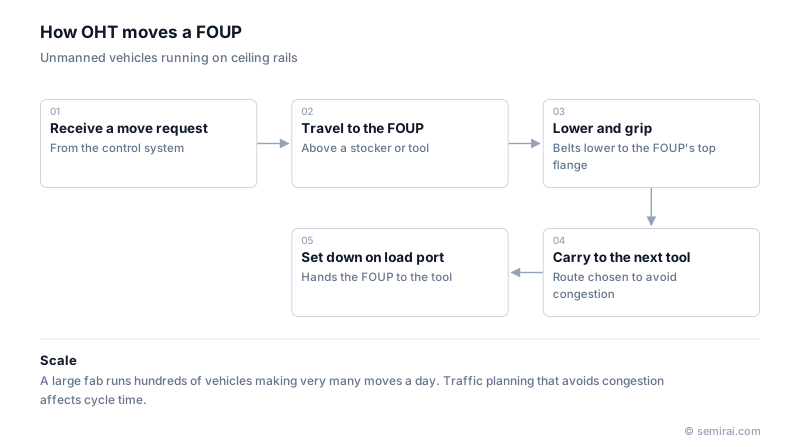
A vehicle stops above the target load port, and a hoist lowers a gripper on belts to the FOUP's top flange, then lifts or sets down the pod. Swinging and sudden acceleration would jolt the wafers, so sway control and smooth motion profiles are important.
Scheduling decides productivity
A large fab runs hundreds of vehicles and makes a very large number of moves each day. The MES issues transport requests, and the AMHS controller assigns vehicles and routes. If requests pile up in one area, vehicles queue, tools wait for wafers and cycle time for the whole fab gets longer.
Controllers therefore predict congestion and spread traffic across routes. Stockers and side-track buffers near bottleneck tools hold FOUPs close by so the tool never runs dry. Because rails must be installed before tools arrive, the OHT layout is fixed early in fab construction.
Japanese companies involved
- Daifuku and Murata Machinery are the leading makers of OHT systems and stockers for semiconductor fabs.
- RORZE makes wafer handling robots and sorters used alongside automated transport.
- Daifuku · Cleanroom automated material handling systems (AMHS)
- Murata Machinery (Muratec) · Stockers and fab automation
- RORZE · Wafer handling robots and sorters
FAQ
What is the difference between OHT and AGV?
An AGV (automated guided vehicle) runs on the floor; an OHT vehicle runs on ceiling rails and uses a hoist to lift carriers. Floor vehicles are still used in some 200 mm fabs and back-end plants, but OHT is standard in 300 mm front-end fabs.
How does OHT affect fab cycle time?
Every step starts with a delivery. If FOUPs arrive late because of congestion, expensive tools sit idle and lots wait longer, which lengthens cycle time. Good routing and buffering keep tools loaded and transport delays short.
Related pages
- Stocker (Automated Wafer Storage)
- FOUP (Front Opening Unified Pod)
- Load Port
- Manufacturing Execution System (MES)
- SEMI E84 (Parallel I/O Handoff)
- Wafer transfer robots and EFEMs
- Automated material handling systems (AMHS)
- Murata Machinery (Muratec) HTC
- Murata Machinery (Muratec) MDS
- Murata Machinery (Muratec) SRC350X
- Murata Machinery (Muratec) SRC600
Sources
Last updated: November 13, 2026