Overall Equipment Effectiveness (OEE)
Overall equipment effectiveness (OEE) is a single ratio that shows how much of a production tool's inherent capacity is actually used to make good products. It combines three kinds of loss, time the tool is stopped, time it runs slowly and time it makes defects, so it is a common starting point for improving factory productivity.
Also called: OEE
Diagram
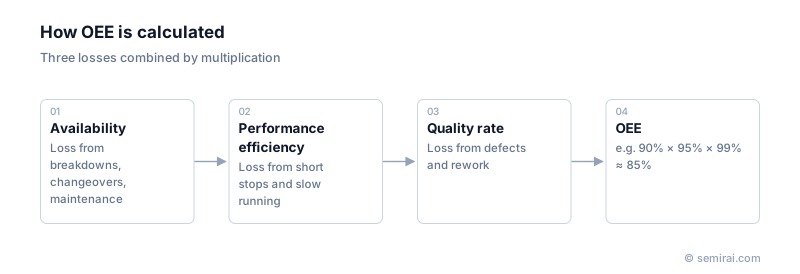
How OEE is calculated
OEE is availability × performance efficiency × quality rate. Availability is the share of planned time in which the tool actually ran; breakdowns, changeovers and maintenance reduce it. Performance efficiency is how much the tool produced while running compared with its ideal rate; short stops and slow running reduce it. Quality rate is the share of output that is good.
If the three factors are 90%, 95% and 99%, OEE is about 85%. Multiplying the factors shows how modest losses in each area add up.
OEE in semiconductor fabs
SEMI E10 defines how equipment time is split into states such as productive, standby, engineering, scheduled downtime and unscheduled downtime, and SEMI E79 defines the equipment productivity and OEE metrics. For very expensive tools such as lithography scanners, a small OEE gain can be worth as much as a large capital investment.
Fabs collect equipment data through SECS/GEM and the manufacturing execution system (MES), analyse why tools stop and use predictive maintenance to cut unscheduled downtime.
Japanese companies involved
- Yokogawa Electric supplies fab software, including MES and equipment communication, used to collect the equipment-state data on which OEE analysis relies.
- Yokogawa Electric · Fab software: MES, equipment communication and cell control
FAQ
How is OEE different from uptime?
Uptime, or availability, only measures the share of time a tool was running. OEE also multiplies in whether the tool ran at its ideal speed and whether its output was good. A tool with high uptime can still have low OEE if it runs slowly or produces many defects.
What is a good OEE value?
It varies widely by industry and tool. Around 85% is often quoted as a high level in general manufacturing. In a semiconductor fab, tools also wait for work because of product mix and line flow, so the breakdown of losses is more useful than the absolute number when choosing what to improve.
Related pages
Sources
Fab infrastructure and equipment parts terms
Last updated: November 13, 2026