Multi-Chip Module (MCM)
A multi-chip module (MCM) is an assembly in which several semiconductor chips are mounted side by side on one substrate and connected by its wiring, so that they can be handled as a single package or component. Instead of building every function into one chip, separately made chips are combined to create a larger circuit.
Also called: MCM, multichip module
Diagram
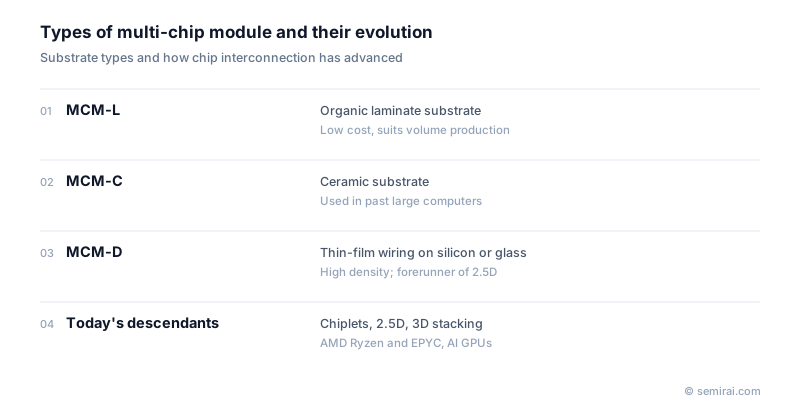
Types by substrate
MCMs were developed intensively in the 1980s and 1990s for high-speed processors in large computers, many of them on ceramic substrates.
They are classified by substrate. MCM-L uses an organic laminate like a printed circuit board. MCM-C uses a ceramic substrate. MCM-D builds thin-film wiring on silicon or glass. In each case chips are linked by short wires inside the package rather than through separate packages and a board, giving higher speed, smaller size and lower power.
From MCM to chiplets
Today's chiplet designs, and processors such as AMD's Ryzen and EPYC that put several CPU dies in one package, extend the MCM idea. 2.5D packages that connect chips densely through a silicon interposer, and 3D stacks that place chips on top of one another, can also be seen as its descendants.
Because several chips go into one package, a single defective die spoils the whole module. Ensuring that every die is a known good die (KGD) before assembly is therefore essential.
Japanese companies involved
- IBIDEN manufactures large organic package substrates on which multi-chip processors and chiplet-based products are assembled.
- IBIDEN · IC package substrates (FC-BGA)
FAQ
What is the difference between an MCM and a SiP?
The terms overlap heavily. MCM emphasises connecting several chips densely on one substrate. System in package (SiP) emphasises giving one package the function of a whole system, usually including passive components alongside the chips.
What is the difference between an MCM and a chiplet?
A chiplet is a design approach: a large chip is split into smaller functional dies that are designed to be combined. An MCM is a form of assembly. Chiplet products are built using MCM, 2.5D or 3D packaging.
Related pages
Sources
Last updated: November 2, 2026