Potting
Potting is an encapsulation method in which liquid resin is poured into a case or frame and left to cure, covering and protecting the chips and components inside. Unlike transfer moulding, which presses resin into a mould under pressure, potting simply lets the resin flow into place, so it adapts easily to products of different shapes and sizes.
Also called: potting encapsulation, glob top
Diagram
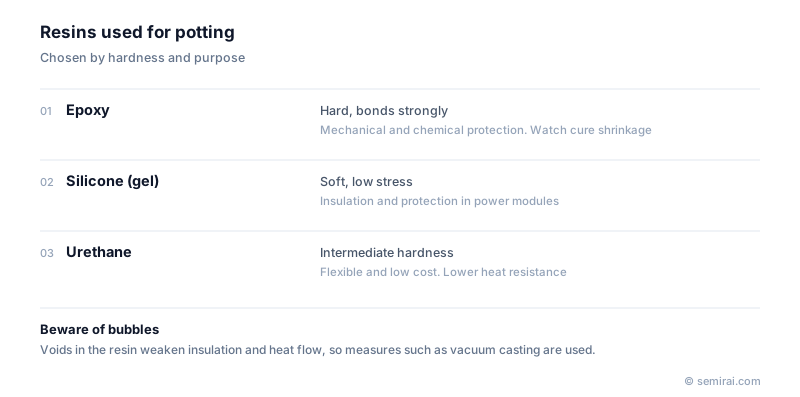
Resins and applications
The resin is chosen for the job. Epoxy is hard and bonds strongly, giving mechanical and chemical protection. Silicone is soft and puts little stress on what it covers. Urethane sits between the two.
The best-known application is power modules, where chips and bond wires inside the case are covered with soft silicone gel. The gel keeps out moisture and dust and prevents electrical discharge between high-voltage parts. Potting is also used for sensors, automotive electronic units and LED lighting.
Glob top and process issues
Dispensing a dome of resin over just a chip on a board, as in chip-on-board assembly, is called glob top.
Bubbles trapped while pouring become weak points for insulation and heat flow, so potting is often done under vacuum and the resin viscosity is adjusted. Cure shrinkage and the expansion mismatch between resin and case as temperature changes can break wires or detach parts, so hardness and CTE must be chosen carefully.
Japanese companies involved
- Shin-Etsu Chemical makes silicone gels and other silicone encapsulants used for potting power modules and electronic units.
- Namics supplies liquid encapsulants, and Musashi Engineering builds the dispensers used to apply potting and glob-top resins precisely.
- Shin-Etsu Chemical · Silicon wafers, photoresists and photomask blanks
- Namics · Underfill and die attach materials
- Musashi Engineering · Dispensers
FAQ
How does potting differ from transfer moulding?
Transfer moulding forces heated resin into a closed mould under pressure and suits high-volume production of identical packages. Potting pours liquid resin into an open case or frame without a mould, which suits varied shapes, large modules and smaller volumes.
Why is silicone gel used in power modules?
Being very soft, it barely loads the wires and solder joints when temperature changes, which helps prevent wire breaks and delamination. It also seals out moisture and insulates the high-voltage regions.
Related pages
Sources
Last updated: November 13, 2026