Electronic Grade Chemicals
Electronic grade chemicals are process chemicals from which metals, particles and other impurities have been removed to extremely low levels for semiconductor and display manufacturing. Typical examples are hydrofluoric acid, sulphuric acid, hydrogen peroxide, ammonia water, hydrochloric acid, nitric acid and isopropyl alcohol (IPA), used in large volumes for cleaning and etching.
Also called: high-purity process chemicals, semiconductor grade chemicals, wet chemicals
Diagram
Why such purity is needed
Wafers are rinsed and cleaned many times during manufacturing, and every chemical that touches them can leave impurities behind. Trace metals such as sodium, iron and copper on the wafer surface can reduce gate oxide reliability and increase junction leakage. For leading-edge processes, metallic impurities in the chemicals are therefore controlled down to the parts-per-trillion (ppt) level.
Particles are controlled just as tightly, as a count of fine particles per millilitre of liquid. This is a completely different standard from industrial or reagent grade chemicals. SEMI standards define purity grades for each chemical according to the application.
Keeping chemicals clean to the point of use
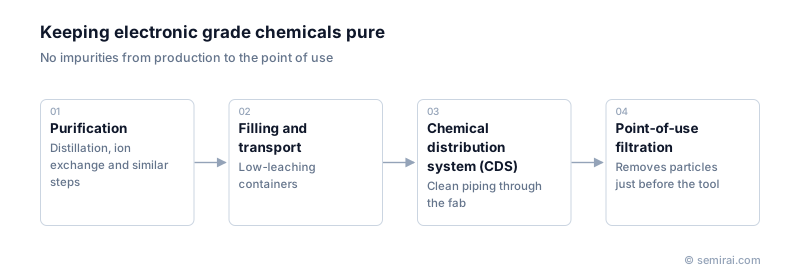
Purity is not only a matter of refining, by distillation, ion exchange and filtration. Every material the chemical touches, including containers, piping, pumps and filters, can leach metals or organics or shed particles. Fluoropolymers and other low-leaching materials are therefore used throughout the supply chain.
Inside the fab, a chemical distribution system (CDS) carries the chemicals from storage tanks to the process tools through clean piping, and the liquid is filtered again at the point of use, just before it reaches the tool.
Japanese companies involved
- Stella Chemifa makes high-purity hydrofluoric acid and other fluorine chemicals for semiconductor cleaning and etching.
- Kanto Chemical supplies high-purity process chemicals for cleaning, etching and CMP, and Mitsubishi Gas Chemical makes high-purity hydrogen peroxide.
- Sumitomo Chemical and Tokuyama also supply electronic chemicals to semiconductor fabs.
- Stella Chemifa · High-purity hydrofluoric acid and fluorine chemicals
- Kanto Chemical · High-purity process chemicals for cleaning, etching and CMP
- Mitsubishi Gas Chemical · High-purity hydrogen peroxide and cleaning chemicals
- Sumitomo Chemical · Photoresists and semiconductor process chemicals
- Tokuyama · Polysilicon and electronic chemicals
- Kanto Denka Kogyo · Fluorine-based specialty gases
FAQ
How do electronic grade chemicals differ from reagents?
Reagent grade chemicals have a guaranteed assay for laboratory and analytical work, but they are not controlled for metals at the ppt level or for fine particles. Electronic grade chemicals specify the impurities that matter for wafer processing, at far stricter limits.
How is ppt-level purity measured?
Trace metals are usually measured with inductively coupled plasma mass spectrometry (ICP-MS), often in clean-room laboratories to avoid contaminating the sample. Particles are counted with liquid particle counters that detect light scattered by individual particles.
Related pages
- Hydrogen Fluoride (HF)
- Metal Contamination
- Ultrapure Water (UPW)
- Total Reflection X-ray Fluorescence (TXRF)
- Point of Use (POU)
- Ion Exchange Resin
- PFAS Regulation
- High-purity electronic chemicals
- Mitsubishi Gas Chemical Super-pure hydrogen peroxide
- Stella Chemifa Ultra-high-purity hydrofluoric acid
- Tokuyama IPA SE
- Tanaka Precious Metals MICROFAB Au
Sources
Last updated: November 12, 2026