Specialty Gas
Specialty gases are the high-purity gases of specific composition used in semiconductor processes, as distinct from bulk gases such as nitrogen, oxygen, argon and hydrogen that are piped to the whole fab. They include deposition gases such as silane and tungsten hexafluoride, etching gases such as CF₄ and chlorine, dopant gases such as arsine and phosphine, and chamber-cleaning gases such as NF₃.
Also called: process gas, electronic specialty gas, ESG
Diagram
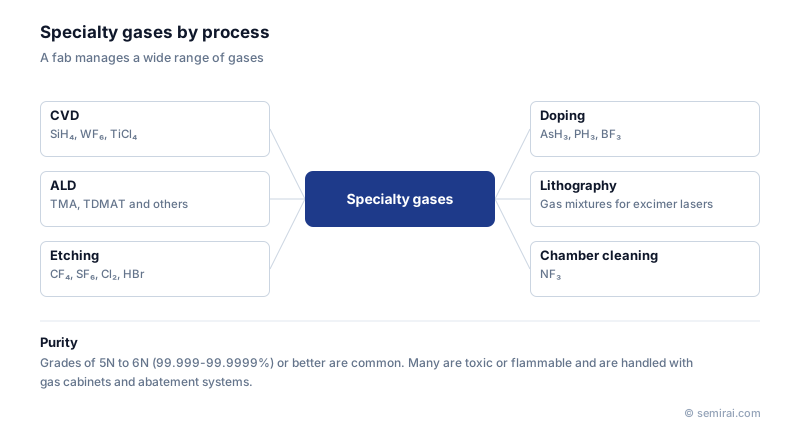
Main families by process
Deposition gases supply the elements of a film: silane (SiH₄) and disilane for silicon and its compounds, tungsten hexafluoride (WF₆) for tungsten plugs, and titanium tetrachloride (TiCl₄) for titanium nitride. Etching gases supply reactive fluorine, chlorine or bromine: CF₄, CHF₃ and C₄F₆ for oxide etching, Cl₂ and HBr for silicon and polysilicon, SF₆ for fast silicon etching and BCl₃ for aluminium. Dopant gases such as arsine (AsH₃), phosphine (PH₃) and boron trifluoride (BF₃) feed ion implanters and doped epitaxy.
Other gases serve less obvious roles. Excimer lasers for lithography run on gas mixtures of a rare gas, fluorine and a neon buffer. NF₃ is widely used to clean CVD chambers through a remote plasma. ALD precursors such as trimethylaluminium are often liquids, vaporised and delivered to the chamber much like gases.
Purity and safety
Impurities in a process gas end up in the film or on the wafer, so moisture, oxygen and metals are held to parts-per-billion levels and purity grades of 5N to 6N (99.999% to 99.9999%) or better are common. Many specialty gases are also dangerous: silane ignites spontaneously in air, arsine and phosphine are highly toxic, and HF and WF₆ are corrosive. Fabs store cylinders in ventilated gas cabinets with leak detectors and automatic shut-off valves, and treat tool exhaust in abatement systems. In Japan, handling is regulated by the High Pressure Gas Safety Act and occupational safety law.
Supply risk and environmental impact
Some gases depend on few sources. Much of the world's semiconductor-grade neon was purified in Ukraine, and the 2022 war exposed this, prompting chipmakers and gas suppliers to diversify and recycle. Fluorinated gases also matter for climate: CF₄, NF₃ and SF₆ have global warming potentials thousands to tens of thousands of times that of CO₂. Fabs destroy them in point-of-use abatement and move to alternatives with lower warming potential where processes allow.
Japanese companies involved
- Taiyo Nippon Sanso supplies specialty and bulk gases, gas supply systems and exhaust abatement equipment to fabs.
- Kanto Denka Kogyo makes fluorine-based specialty gases, and Daikin Industries supplies fluorinated etching gases.
- Resonac (formerly Showa Denko) also produces high-purity gases for electronics manufacturing.
- Taiyo Nippon Sanso · Specialty gases, gas supply systems and MOCVD equipment
- Resonac · CMP slurries, packaging materials and SiC epitaxial wafers
- Daikin Industries · Etching gases, fluoropolymers and fluoroelastomers
- Kanto Denka Kogyo · Fluorine-based specialty gases
FAQ
What is the difference between specialty gases and bulk gases?
Bulk gases such as nitrogen, oxygen, argon and hydrogen are used in large volumes, often produced on or next to the fab site and piped to every tool. Specialty gases are used in much smaller amounts, delivered in cylinders or larger containers, and handled through gas cabinets because many are toxic, flammable or corrosive.
Why are dopant gases sometimes supplied below atmospheric pressure?
Arsine, phosphine and boron trifluoride are extremely hazardous if a cylinder leaks. Sub-atmospheric delivery systems store the gas adsorbed on a porous material so that it flows only when the tool's vacuum draws it out; a leak then pulls air in rather than releasing gas.
Related pages
Sources
Last updated: November 2, 2026