Platen (CMP)
A platen is a flat table or plate. In CMP equipment it is the round rotating table with the polishing pad attached to its top surface. The wafer is pressed against the pad while slurry flows, and both the platen and the polishing head rotate. The word is also used for wafer holders in ion implanters and for flat plates in presses.
Also called: polishing table, polishing platen
Diagram
Role in polishing
Removal rate depends roughly on pressure and on the relative speed between pad and wafer, as described by the Preston equation, so platen speed is a key recipe parameter. The flatness and rotational stability of the platen translate directly into polishing uniformity across the wafer.
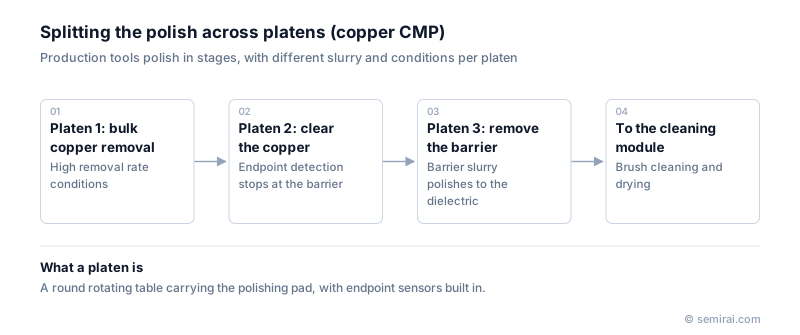
Production CMP tools often have three or so platens in one system and move the wafer between them. In copper CMP, for example, the first platen removes the bulk copper at high rate, the second clears the remaining copper and stops when the barrier is exposed, and the third removes the barrier with a different slurry. Splitting the work lets each stage use its own pad, slurry and conditions.
Sensors and temperature control
Endpoint sensors are built into the rotating platen. Optical systems shine light through a window in the platen and pad and measure reflectance, while eddy-current sensors track the thickness of metal films. Both detect when a film has cleared so the polish can be stopped.
Friction heats the pad during polishing, and removal rate changes with temperature. Some designs circulate cooling water through the platen to keep the pad temperature stable.
Japanese companies involved
- Ebara builds CMP systems with multiple polishing platens.
- Tokyo Seimitsu (ACCRETECH) makes grinding and polishing equipment for wafer thinning.
- Ebara · CMP systems, dry vacuum pumps and exhaust treatment
- Tokyo Seimitsu (ACCRETECH) · Wafer probers, dicing and grinding machines, metrology
FAQ
Why are there windows in CMP pads?
Optical endpoint detection needs a clear path from a sensor in the platen to the wafer surface. A transparent window in the pad, aligned with an opening in the platen, lets the sensor read the reflected light once per rotation.
Does the platen itself wear out?
The platen is a precision part rather than a consumable; the pad on top of it is what wears and is replaced. The platen must stay flat and run true, because any tilt or wobble shows up as non-uniform polishing.
Related pages
Sources
Last updated: November 2, 2026