Stop Layer (Polish Stop)
A stop layer, or polish stop, is a film that polishes much more slowly than the material above it, placed so that CMP effectively stops when it is exposed. In shallow trench isolation the silicon nitride over the active areas plays this role, and a slurry with high oxide-to-nitride selectivity halts removal at the nitride.
Also called: CMP stop layer, polish stop layer, stopper film
Diagram
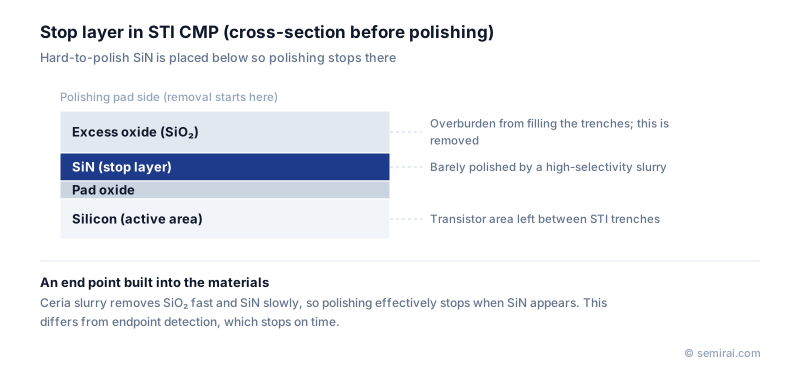
The STI example
In shallow trench isolation (STI), silicon nitride is deposited over a thin pad oxide on the active areas, trenches are etched and then filled with oxide that also covers the nitride. CMP with a ceria-based slurry that removes oxide much faster than nitride takes the excess oxide off and slows almost to a stop when the nitride appears.
The nitride is then removed, typically with hot phosphoric acid, leaving oxide only in the trenches. Without the stop layer the polish could cut into the active silicon. In contrast to endpoint detection, which finds the end point in time, a stop layer builds the end point into the materials.
Selectivity as the design variable
A stop layer only works if the removal rate of the target film is much higher than that of the stop film. Abrasive type and additives, for example molecules that adsorb on the nitride surface and protect it, are chosen to create that selectivity.
Selectivity can also be too high: residual oxide caused by pattern density differences may then never clear, leaving steps inside the chip. The same idea applies to metal CMP. In copper damascene the barrier metal acts as an intermediate stop, and the barrier step switches to a slurry with different selectivity. The balance between target, stop and underlying film sets the amount of dishing and erosion.
Japanese companies involved
- Fujimi Incorporated and Resonac supply CMP slurries, including formulations designed for selective polishing.
- Ebara builds the CMP systems on which such stop-layer processes run.
- Fujimi Incorporated · CMP slurries and polishing materials
- Resonac · CMP slurries, packaging materials and SiC epitaxial wafers
- Ebara · CMP systems, dry vacuum pumps and exhaust treatment
FAQ
Why add an extra film just to stop polishing?
Because it gives depth reproducibility that timing alone cannot. Removal rate drifts with pad condition and pattern density, so a timed polish would land at different depths. The extra deposition and removal steps cost money, but they make the final height of the structure predictable.
Does the stop layer remain in the finished device?
It depends on the process. The STI nitride is stripped after polishing, while in other flows a stop film may stay and serve a later purpose, such as an etch stop or part of the dielectric stack.
Related pages
Sources
Last updated: November 13, 2026