CMP Equipment (Polisher)
CMP equipment is the production tool that carries out chemical mechanical polishing. It holds the wafer in a polishing head, presses it against a pad on a rotating platen while slurry is supplied, and planarises the surface to nanometre level. Modern tools also clean and dry the wafer, so it enters and leaves the system dry.
Also called: CMP tool, CMP polisher, CMP system
Diagram
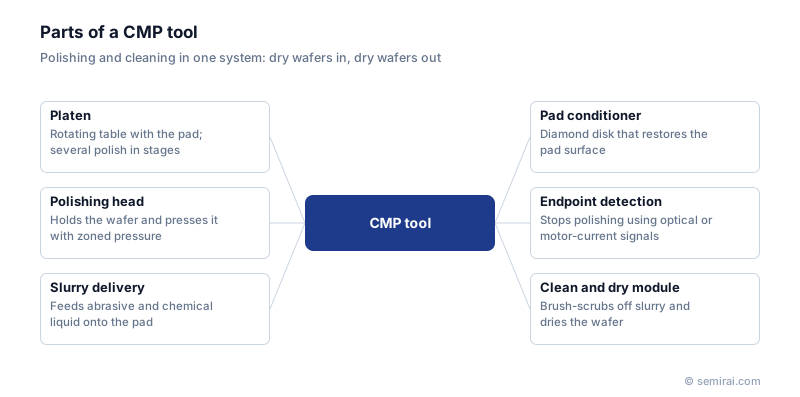
Main parts of the tool
The platen is a rotating table carrying the polishing pad; production tools have several platens so polishing can be split into stages. The polishing head holds the wafer with a membrane and a retainer ring and presses it against the pad, usually with separately controlled pressure zones. A slurry delivery system meters the polishing liquid onto the pad.
A pad conditioner, a disk set with diamond grit, regularly roughens the pad so that it keeps polishing at a steady rate. Endpoint detection, using optical reflectance, motor current or eddy-current sensing, tells the tool when a film has cleared. A cleaning module then scrubs off slurry with brushes and dries the wafer before the slurry can dry onto it.
Controlling uniformity
Uniformity is the central challenge. Multi-zone pressure control in the head lets the tool correct the radial thickness profile, while the retainer ring and pad conditioning keep the wafer edge in line with the centre. Pattern-dependent effects such as dishing and erosion are managed together with slurry design.
The same basic platform is configured differently for each application: STI oxide CMP, tungsten CMP for contacts and vias, copper and barrier CMP for damascene wiring, and gate CMP for metal gate processes. Each uses its own slurry, pad and recipe.
Japanese companies involved
- Ebara develops and manufactures CMP systems for semiconductor fabs.
- SpeedFam makes wafer polishing and lapping equipment, and Okamoto Machine Tool Works makes polishers and grinders.
- Asahi Diamond Industrial makes diamond pad conditioners, and Nitta DuPont makes polishing pads used on these tools.
- Ebara · CMP systems, dry vacuum pumps and exhaust treatment
- Okamoto Machine Tool Works · Wafer polishers and grinders
- Asahi Diamond Industrial · Dicing blades, grinding wheels and CMP pad conditioners
- Nitta DuPont · CMP and wafer polishing pads
- SpeedFam · Wafer polishing and lapping equipment
FAQ
Why does a CMP tool include a cleaning module?
Slurry particles that dry on the wafer become very hard to remove and cause defects. Integrating brush scrubbing, rinsing and drying in the same tool means the wafer is cleaned immediately after polishing, which is why CMP systems are described as dry-in, dry-out.
Why do CMP tools have several platens?
Different stages of a polish need different pads, slurries and conditions. For copper, one platen can remove the bulk metal quickly, a second clears the remaining copper and stops on the barrier, and a third removes the barrier. Running the stages in parallel on separate platens also raises throughput.
Related pages
Sources
Last updated: November 2, 2026