Spin Rinse Dryer (SRD)
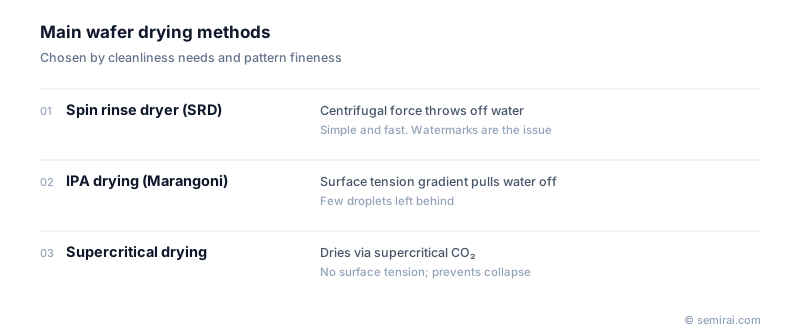
A spin rinse dryer (SRD) is equipment that rinses wafers with ultrapure water while rotating them and then spins them at high speed so that centrifugal force throws off the water and dries them. Because rinsing and drying are done in one unit, SRDs have long been used to finish wet processes after cleaning or etching.
Also called: SRD, spin dryer
Diagram
Batch and single-wafer types
The classic SRD is a batch tool: a cassette of wafers is spun inside a chamber, typically after chemical processing in a wet bench. Ultrapure water sprays wash away the chemicals, the rotation speed is raised to throw off the water, and heated nitrogen is often blown in to finish drying.
Single-wafer versions spin one wafer at a time. In single-wafer cleaning systems, cleaning, rinsing and drying are usually done in the same process chamber.
Watermarks and alternatives
The main problems are watermarks, residues left when small droplets dry and leave behind dissolved material such as silica, and particles stirred up during drying that land back on the wafer. Hydrophobic silicon surfaces, such as those after HF treatment, hold droplets and are especially prone to watermarks.
Where higher cleanliness is required, IPA drying (Marangoni drying), which uses a surface tension gradient to pull water off the wafer, is used instead. For very fine patterns, supercritical drying avoids surface tension altogether.
Japanese companies involved
- SCREEN Holdings, Tokyo Electron and Shibaura Mechatronics build wet cleaning systems that include rinsing and drying.
- Kaijo makes ultrasonic cleaning systems.
- SCREEN Holdings · Wafer cleaning, coat/develop and inspection equipment
- Tokyo Electron (TEL) · Coat/develop, etch and deposition equipment
- Shibaura Mechatronics · Photomask cleaning and carrier cleaning equipment
- Kaijo · Wire bonders and ultrasonic cleaning systems
FAQ
Why do watermarks form in spin drying?
When small droplets left on the wafer dry, the traces of dissolved silicon, oxygen reaction products or contamination they carry stay on the spot. On hydrophobic silicon after HF treatment, water beads up and lingers, so watermarks form more easily.
How does an SRD differ from IPA drying?
An SRD removes water by centrifugal force. IPA drying uses the difference in surface tension between water and isopropyl alcohol to draw water off the surface, leaving fewer droplets, so watermarks and particle redeposition are easier to suppress.
Related pages
Sources
Last updated: November 1, 2026