SC1 Cleaning (APM)
SC1 cleaning is a wet cleaning step that uses a mixture of ammonium hydroxide (NH₄OH), hydrogen peroxide (H₂O₂) and deionised water to remove particles and organic contamination from silicon wafers. It is the first solution of RCA cleaning, and from its ingredients it is also called APM, the ammonia-peroxide mixture.
Also called: SC-1, APM clean, ammonia-peroxide mixture, RCA standard clean 1
Diagram
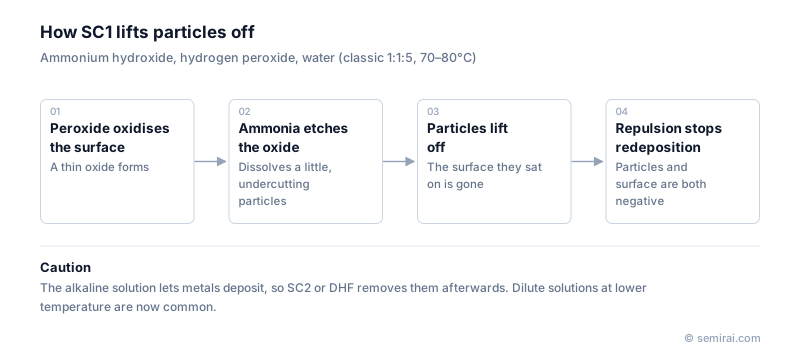
How SC1 removes particles
RCA cleaning was developed by Werner Kern and colleagues at RCA in the 1960s, and SC1 stands for Standard Clean 1. The classic recipe is NH₄OH : H₂O₂ : H₂O = 1 : 1 : 5 at about 70–80°C.
Two reactions run at the same time. The peroxide oxidises the silicon surface into a thin oxide, and the ammonia slowly dissolves that oxide. The surface is therefore etched very slightly, undercutting and lifting off particles that were sitting on it. In the alkaline solution both the wafer and most particles carry a negative surface charge (a negative zeta potential), so detached particles are repelled and do not settle back.
Limits and modern practice
Metals such as iron, aluminium and zinc tend to deposit on the surface from alkaline solutions, and SC1 can roughen silicon slightly. It is therefore followed by SC2, an acidic hydrochloric acid and peroxide mixture that removes metals, and often by dilute hydrofluoric acid (DHF).
Today much more dilute SC1 mixtures are common, often at lower temperature, to reduce silicon loss and chemical use. The weaker chemical action is made up with physical force from megasonic agitation or two-fluid sprays. SC1 is run both in batch wet benches and in single-wafer cleaning tools.
Japanese companies involved
- SCREEN Holdings and Tokyo Electron build batch and single-wafer cleaning systems that run SC1 and related cleans.
- Mitsubishi Gas Chemical supplies high-purity hydrogen peroxide, and Kanto Chemical supplies high-purity process chemicals used in such cleaning.
- SCREEN Holdings · Wafer cleaning, coat/develop and inspection equipment
- Tokyo Electron (TEL) · Coat/develop, etch and deposition equipment
- Mitsubishi Gas Chemical · High-purity hydrogen peroxide and cleaning chemicals
- Kanto Chemical · High-purity process chemicals for cleaning, etching and CMP
FAQ
What is the difference between SC1 and SC2?
SC1 is alkaline (ammonia and peroxide) and mainly removes particles and organics. SC2 is acidic (hydrochloric acid and peroxide) and mainly removes metal contamination. Because SC1 leaves metals behind more easily, the basic RCA order is SC1 followed by SC2.
Why is the amount of silicon removed by SC1 controlled?
Each SC1 step consumes a little of the surface. Repeated many times in a process flow, that loss can thin critical layers and roughen the surface. Controlling concentration, temperature and time keeps the etch to the minimum needed to lift particles.
Related pages
Sources
Last updated: November 2, 2026