End Station (Ion Implanter)
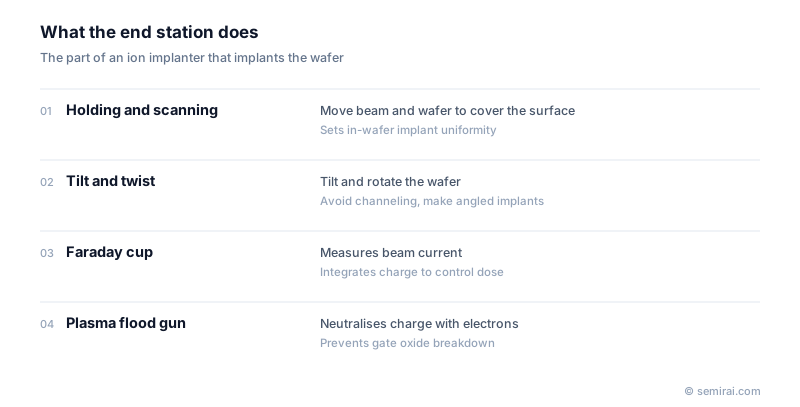
The end station is the part of an ion implanter that holds the wafer and where the ion beam is actually implanted into it. It scans beam and wafer to cover the whole surface uniformly, sets the wafer tilt and rotation, measures the dose with a Faraday cup and neutralises wafer charging with a plasma flood gun.
Also called: implant chamber, process chamber
Diagram
Where it sits in the implanter
An ion implanter has four main parts: an ion source that creates ions, a mass analyser that selects only the wanted ion, a beamline that accelerates and shapes the beam, and the end station. The end station is kept under vacuum; wafers enter and leave through load locks and return to the handling system after implantation.
The beam is smaller than the wafer, so the whole surface is covered by sweeping the beam electrically or magnetically, by moving the wafer mechanically, or by both. Older machines mounted many wafers on a spinning disk (batch type); today most implanters process one wafer at a time. The wafer sits on a platen, often an electrostatic chuck, which removes heat from the beam and sets the tilt and twist angles precisely to avoid channeling or to make angled implants.
Dose control and charging
A Faraday cup near the wafer collects the beam current, which is integrated over time to give the number of ions delivered. Implantation stops when the target dose is reached, and the scan is adjusted to keep the dose uniform across the wafer.
Positive ions keep adding charge to insulating films and photoresist, which can break down thin gate oxides. A plasma flood gun supplies low-energy electrons that neutralise this charge. Outgassing from photoresist also changes the vacuum and can neutralise part of the beam, causing dose errors, so it is monitored and corrected.
Japanese companies involved
- Nissin Ion Equipment and Sumitomo Heavy Industries Material Solutions (formerly SMIT) design and build complete ion implanters, including their end stations, wafer handling and dose control systems.
- Nissin Ion Equipment · Ion implanters
- Sumitomo Heavy Industries Material Solutions (formerly SMIT) · Ion implanters
FAQ
Why do implanters measure beam current instead of counting ions on the wafer?
Individual ions cannot be counted directly at production rates. Each ion carries a known charge, so integrating the current collected by a Faraday cup over time gives the dose with good accuracy, as long as the beam's charge state is known.
Why did implanters move from batch to single-wafer end stations?
Single-wafer end stations give better control of the implant angle across the whole wafer, which matters for tilted, halo and 3D-structure implants. Wafer size growth to 300 mm also made large spinning batch disks less practical for many applications.
Related pages
Sources
Ion implantation and thermal processing terms
Last updated: November 2, 2026