Removal Rate (Preston Equation)
Removal rate is the thickness of film removed per unit time in CMP, usually given in nm/min. The Preston equation, which says removal rate is proportional to polishing pressure times relative velocity, is the usual starting point, but slurry chemistry, pad condition and pattern density also have strong effects, so the rate drifts and must be controlled.
Also called: polishing rate, material removal rate, MRR
Diagram
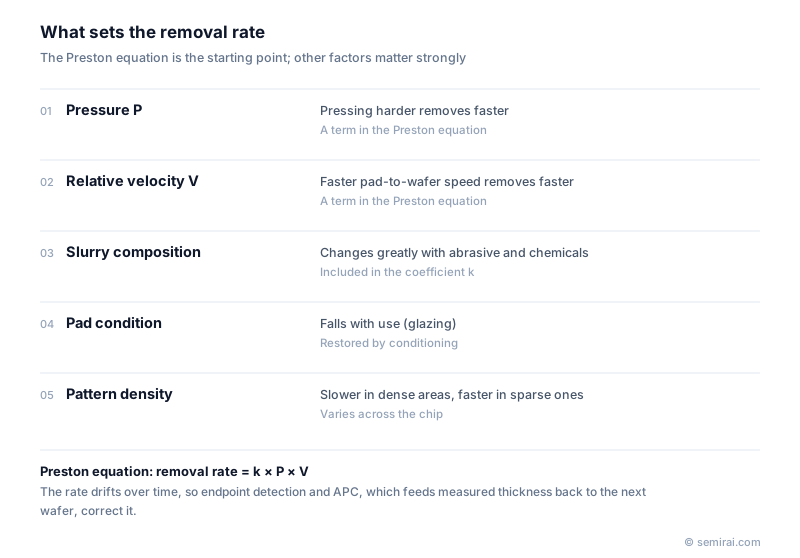
The Preston equation
The empirical Preston equation is written RR = k × P × V, where P is the pressure on the wafer, V is the relative speed between pad and wafer, and k, the Preston coefficient, lumps together the effects of the film material, slurry and pad. It was originally developed for glass polishing.
In CMP the chemistry contributes a great deal, and the rate often departs from a straight line at low or high pressure and speed. The equation is therefore used as a design guide: more pressure and more speed generally mean faster removal, but the actual value has to be measured.
What makes the rate drift, and how fabs correct it
Many factors move the real rate: abrasive concentration, pH and oxidiser level in the slurry; pad surface condition, which degrades by glazing; pad conditioning settings; slurry flow and temperature; and the pattern density of the chip. Because the pad changes with use, the same recipe gives a slowly changing rate.
Fabs handle this with endpoint detection during polishing, using motor current or optical signals to stop when a film clears, and with advanced process control (APC) afterwards. The film thickness is measured after polishing and the result is fed back to adjust the time for the next wafer or lot, absorbing pad ageing.
Japanese companies involved
- Ebara builds CMP systems, and endpoint detection and rate control are part of the process capability such tools provide.
- Ebara · CMP systems, dry vacuum pumps and exhaust treatment
FAQ
Is a higher removal rate always better?
No. Raising pressure to gain rate increases scratches, dishing and the risk of peeling fragile low-k films. The setpoint is a compromise between throughput and defects and flatness, and many processes deliberately use a slower final stage.
Why is removal rate slower in dense pattern areas?
Where features are dense, the load from the pad is shared across more raised area, so the effective local pressure is lower than on isolated features. This pattern-density effect is one reason chip designers add dummy fill to make density more uniform.
Related pages
Sources
Last updated: November 2, 2026