Resist Strip
Resist strip is the step that removes photoresist from the wafer after it has served as a mask for etching or ion implantation. Because a chip goes through dozens of lithography and etch cycles, stripping is repeated each time and is one of the most frequent steps in the flow. The resist must be removed completely without damaging the films underneath.
Also called: photoresist removal, resist stripping, ashing
Diagram
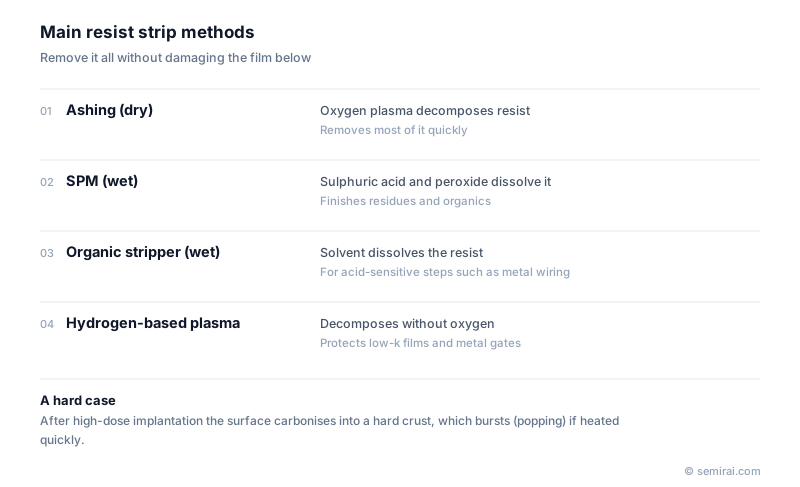
Dry and wet methods
There are two broad approaches. Ashing is the dry method: an oxygen plasma breaks down the resist, much like burning it away. The wet method dissolves resist with a sulphuric acid and hydrogen peroxide mixture (SPM) or with organic strippers.
Many steps combine the two. Ashing removes most of the resist quickly, and a wet clean then removes the remaining residues and contamination. Organic strippers are used where acids would attack exposed metal wiring.
Difficult cases
The hardest case is resist used as a mask for high-dose ion implantation. The implanted surface carbonises into a hard crust that resists normal conditions. If the wafer is heated too quickly, gas trapped beneath the crust bursts it (popping), scattering particles. Gradual temperature ramps and adjusted chemistries are used to avoid this.
When the underlying film is sensitive to oxygen plasma or chemicals, as with low-k dielectrics or metal gates, hydrogen-based plasmas or lower temperatures are chosen so that the film below is not damaged.
Japanese companies involved
- ULVAC makes plasma ashing equipment for resist removal.
- Tokyo Electron and SCREEN Holdings build wet processing and cleaning systems used for post-ash cleaning and wet stripping.
- ULVAC · Vacuum deposition (sputtering) equipment and vacuum pumps
- Tokyo Electron (TEL) · Coat/develop, etch and deposition equipment
- SCREEN Holdings · Wafer cleaning, coat/develop and inspection equipment
FAQ
What is the difference between ashing and resist strip?
Resist strip is the whole step of removing used resist. Ashing is one method within it, using a plasma, usually oxygen-based, to decompose the resist. Wet methods with SPM or organic strippers are the other, and the two are often combined.
Why is resist hard to remove after ion implantation?
High-energy ions drive hydrogen and other elements out of the organic resist surface, carbonising it into a hard crust. The crust resists plasma and chemicals, and rapid heating can make it burst from gas trapped underneath. Careful, stepwise heating and tailored chemistry are used to remove it.
Related pages
Sources
Last updated: November 13, 2026