Silent Data Corruption (SDC)
Silent data corruption (SDC) is a phenomenon in which a chip such as a CPU or GPU produces incorrect computation results without signalling any error. Programs keep running and no warning appears, so the wrong data is stored or used in later calculations. Reports from Google and Meta in 2021 about their own server fleets brought it wide attention.
Also called: SDC, silent data error, mercurial cores
Diagram
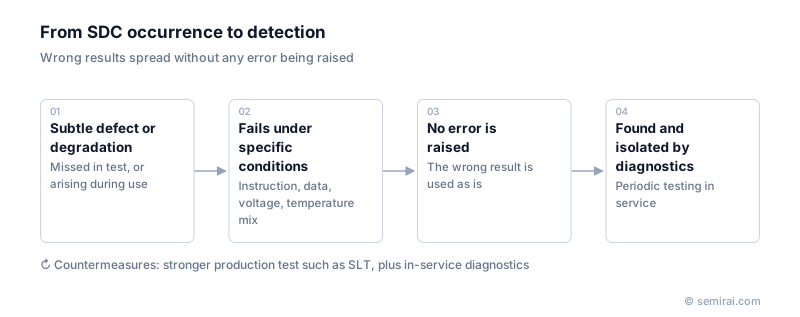
Causes and why it is hard to find
Most cases come from subtle manufacturing defects that production test missed, or from degradation that develops during use. They appear only under narrow conditions: a particular instruction, particular data values, or a particular combination of voltage and temperature.
Because the fault lies in the logic itself, existing error-correction mechanisms such as memory ECC do not detect it. The rate per chip is low, but in data centres running hundreds of thousands or millions of servers, the total becomes significant.
Countermeasures
Chip makers have strengthened production test, adding system-level test (SLT), which runs workloads close to real software, and revising test patterns to raise coverage of the defects that cause SDC.
Data centre operators run diagnostic programs on servers in service, periodically and during maintenance windows, to find suspect cores and remove them from use. The growth of AI training, in which many chips compute for long periods and a single wrong result can spoil a run, has made these measures more important.
Japanese companies involved
- Advantest offers system-level test equipment as well as conventional ATE, the type of testing chip makers have added to screen for defects that lead to SDC.
- Advantest · Automated test equipment (ATE) for SoC and memory
FAQ
How is SDC different from a soft error?
A soft error is a random, one-off bit flip caused by radiation and often caught by ECC. SDC usually refers to a defect or degradation inside the logic that produces wrong results repeatably under certain conditions and passes undetected by existing checks, so the wrong data is used.
Why does production test miss SDC defects?
The faulty behaviour may need a precise combination of instruction, data, voltage and temperature that the test patterns never create. Some defects also appear only after ageing in the field. Shipment test alone cannot catch everything, which is why in-service diagnostics are needed.
Related pages
Sources
Last updated: November 1, 2026