Strobe (Tester Compare Timing)
In semiconductor testing, a strobe is the timing at which automatic test equipment (ATE) samples an output of the device under test (DUT) within each cycle and compares it with the expected value. The term also refers to the sampling action itself. Like a camera flash, it looks at the signal at one defined instant.
Also called: compare strobe, edge strobe, window strobe
Diagram
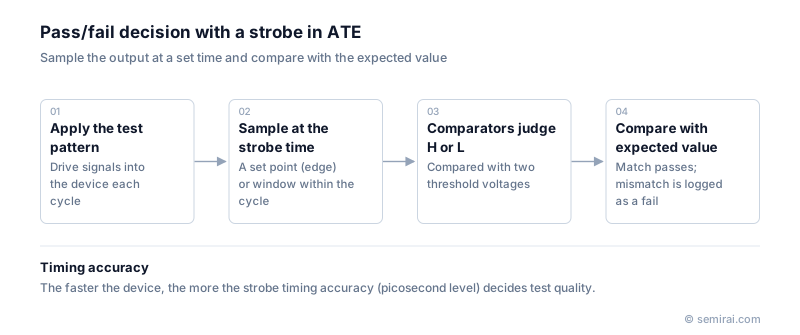
How strobing works
The ATE drives input signals into the device according to a test pattern, made of test vectors, and samples each output at a programmed time within the cycle, the strobe edge. Comparators with two threshold voltages decide whether the sampled level is high, low or in between. If the result matches the expected value, the pin passes for that cycle.
Besides an edge strobe, which samples at a single instant, testers offer a window strobe. It checks that the output stays at the expected level throughout a time window, which catches glitches that an edge strobe could miss.
Measuring timing with the strobe
Moving the strobe step by step through the cycle shows when the output becomes valid, which gives the output delay, and how much timing margin remains. Sweeping strobe time against supply voltage and plotting pass or fail produces a shmoo plot, a quick picture of the device's operating margin.
For fast devices the accuracy of strobe placement, at the picosecond level, directly limits test quality. A timing error in the tester either rejects good parts or lets marginal ones through, so testers are calibrated to remove skew between channels.
Japanese companies involved
- Advantest designs the timing generators, comparators and per-pin electronics that place strobes in its SoC and memory test systems.
- Advantest · Automated test equipment (ATE) for SoC and memory
FAQ
What is the difference between an edge strobe and a window strobe?
An edge strobe samples the output once at a fixed point in the cycle. A window strobe checks the output continuously over an interval and fails if it leaves the expected level at any time, so it is used to detect glitches and unstable outputs.
Is a data strobe in DDR memory the same thing?
Not quite. In DDR memory interfaces the data strobe (DQS) is a signal sent along with the data to tell the receiver when to sample it. It plays the same role of marking the sampling instant, but it is part of the device interface rather than a tester setting.
Related pages
Sources
Last updated: November 13, 2026