Test Head
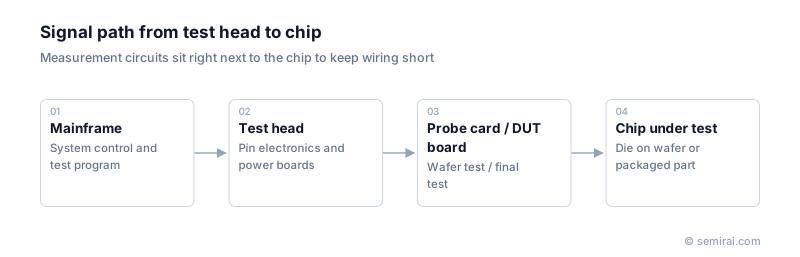
The test head is the part of semiconductor automatic test equipment (ATE) that sits right next to the chip under test and holds the circuits that send and receive signals. ATE is divided into the mainframe, which controls the whole system, and the test head, which is packed with pin-electronics boards, device power supply boards and analogue or RF instrument boards.
Also called: ATE test head
Diagram
Why it sits close to the chip
Keeping the measurement circuits close shortens the signal paths, which is essential for driving and receiving high-speed signals accurately. Long cables would add delay, attenuation and reflections that the tester could not fully correct.
In wafer test, the test head is lowered onto a wafer prober and connects to the chips on the wafer through a probe card. In final test after packaging, the test head is connected to a test handler and reaches the chip through a DUT board (load board) and a test socket.
Docking and configuration
Test heads are heavy, so they are held by a support mechanism called a manipulator, which lifts and rotates them and aligns them to the prober or handler. Attaching the head precisely so that its contacts mate with the probe card or DUT board is called docking.
The number of chips one test head can measure at the same time and the types and number of boards it can hold largely determine the throughput and cost of test. Test heads are therefore configured per product, with more digital channels, more power supplies or RF instruments as needed.
Japanese companies involved
- Advantest builds SoC and memory test systems whose test heads are configured with pin-electronics, power and instrument boards for each application.
- Tokyo Seimitsu (ACCRETECH) makes wafer probers onto which test heads are docked for wafer-level testing.
- Tokyo Seimitsu (ACCRETECH) · Wafer probers, dicing and grinding machines, metrology
- Advantest · Automated test equipment (ATE) for SoC and memory
FAQ
What is the difference between the test head and the mainframe?
The mainframe holds the system controller, the computer that runs the test program, and support functions such as main power and cooling. The test head holds the per-pin circuits and instruments that touch the device. The two are linked by cables, and the split keeps the sensitive electronics close to the chip.
What does docking mean?
Docking is mounting the test head onto a prober or handler in the right position and orientation. The manipulator brings the head into place and a docking mechanism locks it so that the contacts on the probe card or DUT board line up. Good docking repeatability reduces contact problems and set-up time.
Related pages
Sources
Last updated: November 13, 2026