System Level Test (SLT)
System level test (SLT) checks a packaged chip by running it in conditions close to real use, typically booting an operating system or running application workloads on a board that mimics the end system. It finds defects that wafer test and conventional automatic test equipment (ATE) tests struggle to detect, such as failures that appear only when many blocks run together.
Also called: SLT, system-level test
Diagram
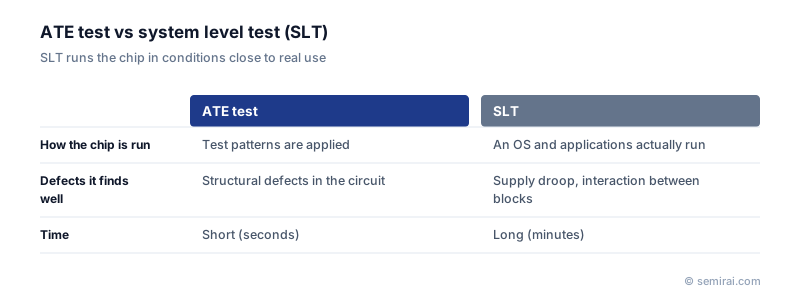
What SLT catches
Structural tests generated by ATPG apply patterns through scan chains and are very good at finding manufacturing defects in the logic. They do not, however, reproduce the full chip running at speed with real power delivery, temperature and traffic between blocks. Some failures only appear under those conditions: supply-voltage droop when many cores switch together, timing marginalities, thermal effects, and interactions between subsystems or with firmware.
SLT closes that gap by doing what the customer will do. The chip sits in a socket on an application-like board, boots, and runs test programs or real workloads. If it hangs, crashes or produces wrong results, it is rejected.
Cost and where SLT is used
The weakness of SLT is time. An ATE test takes seconds, while an SLT run takes minutes, so SLT needs many sites working in parallel and adds noticeable cost per chip. Depending on the product and quality target, it is applied to every unit or only to selected lots or risk categories.
SLT is most common for complex chips such as AI processors, data-centre SoCs and smartphone application processors. As these move to chiplets and HBM stacks, the assembled package has to be proven as a whole, which increases the role of SLT after packaging. Data from SLT failures is also fed back to improve design-for-test and earlier test steps.
Japanese companies involved
- Advantest, the Japanese test equipment maker best known for its SoC and memory ATE, also offers system-level test systems.
- Advantest · Automated test equipment (ATE) for SoC and memory
FAQ
How is SLT different from final test?
Final test on ATE checks a packaged chip's electrical parameters and runs structural and functional patterns. SLT checks behaviour by running the chip as a system with real software. The line between them is blurring, and names such as in-system test are also used.
Can better DFT replace SLT?
Not completely. Better fault models and coverage reduce what slips through structural tests, but effects such as power-delivery noise under real workloads are hard to model. Many makers of high-end chips therefore keep SLT as a final safety net.
Related pages
- Automated Test Equipment (ATE)
- Burn-In Test
- Design for Testability (DFT)
- Probe Card
- Final Test
- DPPM (Defective Parts Per Million)
- Fault Coverage
- Silent Data Corruption (SDC)
- System-level test (SLT) equipment
- Final test equipment
- Advantest 7038 System-Level Test System
- Advantest 7038 Single Slot Tester (SST)
- Advantest 7038 STR
- Advantest ActivATE™
Sources
Last updated: November 13, 2026