Test Socket / Contactor
A test socket, or contactor, is the contact component that electrically connects the terminals of a packaged device to the device-under-test (DUT) board during final test. It plays the role after packaging that the probe card plays in wafer test: a test handler presses each device into the socket, and the tester measures it through the contacts.
Also called: test socket, contactor, IC test socket
Diagram
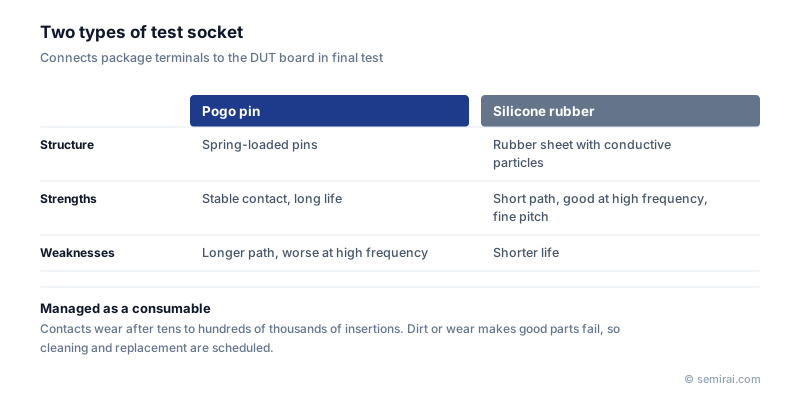
Pogo-pin and elastomer sockets
Pogo-pin sockets use thin spring-loaded pins pressed against each terminal. Contact is stable and the pins survive many insertions, but the length of the pin adds inductance, which limits performance with very high-speed signals.
Elastomer (silicone rubber) sockets use a sheet of insulating rubber with columns of conductive particles. When the device is pressed down, the rubber compresses and the particles form a conductive path. The path is very short, giving good high-frequency behaviour and easy support for fine pitches, but the sheet usually wears out sooner than spring pins.
What a socket must deliver
A good socket offers low and stable contact resistance, repeatable contact over many cycles, good signal integrity and the ability to carry high current. Modern processors draw large supply currents, so contact resistance on the power pins causes heating and voltage drop that can distort measurements. Contact force must also be set so that the solder balls of BGA packages are not damaged.
Sockets also have to work at temperature. In hot and cold test, thermal expansion can shift alignment and change material properties, and the design must allow for this.
Japanese companies involved
- Japanese connector makers such as Yamaichi Electronics and Enplas produce IC sockets used for semiconductor testing and burn-in.
- Advantest · Automated test equipment (ATE) for SoC and memory
FAQ
Is a test socket a consumable?
Yes. After a large number of insertions, often quoted in the tens to hundreds of thousands, pins wear and solder or flux residue builds up on the contacts. Resistance then rises on some pins, and good parts are wrongly rejected (overkill). Regular cleaning and planned replacement are therefore part of keeping test yield high.
Who presses the device into the socket?
A test handler. It picks packaged devices from trays or tubes, brings them to the test temperature, plunges them into the socket with a controlled force, and sorts them into bins according to the tester's result.
Related pages
Sources
Last updated: November 2, 2026