Soft Error
A soft error is a temporary error in which a 0 or 1 stored in memory or a latch is flipped when radiation strikes the chip, such as neutrons from cosmic rays or alpha particles from trace radioactive impurities in package materials. The chip itself is not damaged, and rewriting the data restores it, which distinguishes soft errors from hard errors.
Also called: single-event upset, SEU, radiation-induced bit flip
Diagram
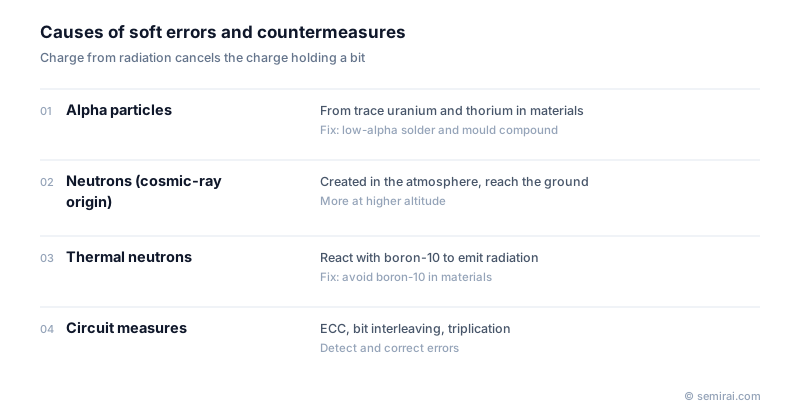
Where the radiation comes from
Alpha particles come from tiny amounts of uranium and thorium in package and solder materials. Neutrons are produced when cosmic rays collide with the atmosphere; they reach the ground, and their flux is higher at altitude and much higher at aircraft cruising heights. Thermal neutrons can also cause errors by reacting with the isotope boron-10 in chip materials, which then emits charged particles.
As a particle passes through silicon it creates electric charge. If that charge is comparable to the charge holding a stored bit, the bit flips. Scaling reduces the stored charge, so less deposited charge is enough to cause an upset.
Measuring and preventing soft errors
Soft error rate is expressed in FIT, failures per billion device-hours, and JEDEC JESD89 defines the test methods, including accelerated testing with alpha sources and neutron beams.
Countermeasures include low-alpha solder and mould compounds, error-correcting codes (ECC) on SRAM and DRAM, physically interleaving the bits of one word so a single strike cannot flip several of them, and triplicating critical circuits with majority voting. Avoiding boron-10 in materials near the transistors addresses thermal neutrons. Automotive, server and aerospace applications put the most weight on these measures.
Japanese companies involved
- Renesas Electronics, a major supplier of automotive microcontrollers, protects on-chip memories with ECC, a standard defence against soft errors in safety-related systems.
- Renesas Electronics · Microcontrollers, automotive SoCs, analog and power chips
FAQ
What is the difference between a soft error and a hard error?
A soft error changes stored data temporarily; the hardware is fine and works correctly after the data is rewritten. A hard error comes from physical damage such as a broken line or a degraded transistor. It recurs at the same location and cannot be fixed by rewriting.
Do soft errors increase on aircraft?
Yes. Atmospheric neutrons are created by cosmic rays, and their flux rises with altitude, so at cruising altitude it is far higher than at sea level. Avionics and space electronics therefore use stronger protection, such as radiation-tolerant designs and more aggressive error correction.
Related pages
Sources
Last updated: November 1, 2026