DPPM (Defective Parts Per Million)
DPPM (defective parts per million) is a quality metric that counts the number of defective units in every million shipped. It quantifies test escapes, the faulty parts that pass testing and reach customers, and it is a central figure in quality agreements between chip suppliers and their customers.
Also called: defective parts per million, test escapes, defect level
Diagram
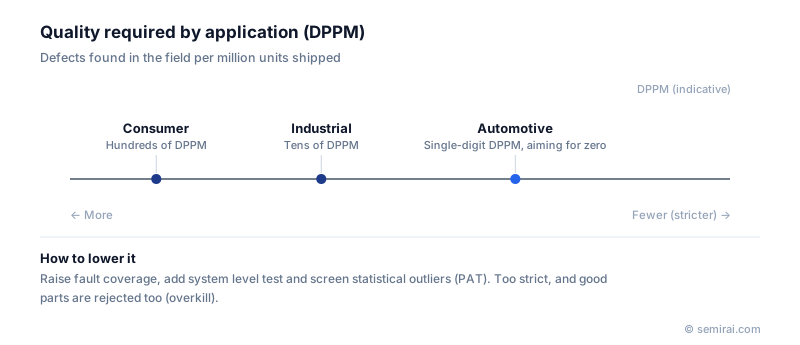
Targets differ by application
Required levels vary widely. Consumer products may tolerate tens to hundreds of DPPM, industrial equipment asks for less, and automotive customers expect single-digit DPPM, with zero defects as the stated goal for safety-related parts. Where a single failure could cause an accident, suppliers accept higher test cost to keep escapes down.
Reducing DPPM involves both test and design. On the test side, suppliers raise fault coverage beyond stuck-at faults to include transition faults and IDDQ (quiescent supply current) tests, add system level test (SLT) under realistic conditions, and use burn-in to remove early failures. On the design side, good DFT structures make high coverage possible in the first place.
Escapes versus overkill
More testing costs more and raises the risk of overkill, where good parts are wrongly rejected. Rejections caused by poor contact or noise lower yield for no reason and also distort the statistics of real defects. Managing DPPM means balancing escapes against overkill as well as against cost.
Statistical methods are now widely used to strike this balance. Part average testing (PAT) rejects dies whose measurements are outliers compared with their neighbours on the same wafer, even if they are within specification; the automotive guideline AEC-Q001 describes it. Adaptive test adds or removes test items based on the recent history of good results.
Japanese companies involved
- Test strategies that lower DPPM run on automatic test equipment such as Advantest's SoC and memory testers, where outlier screening and adaptive test are applied to production data.
- Advantest · Automated test equipment (ATE) for SoC and memory
FAQ
How is DPPM different from yield?
Yield is the share of manufactured parts that pass test and is mainly a cost issue for the supplier. DPPM measures defective parts among those that passed and were shipped, so it describes the quality the customer receives.
How is DPPM measured in practice?
From customer returns and line rejects that are confirmed by failure analysis to be supplier defects, divided by the number of units shipped over the same period. Because the numbers are small, results are usually tracked over long periods and large volumes.
Related pages
Sources
Last updated: November 2, 2026