Fault Coverage
Fault coverage is the percentage of faults in an assumed fault model that a set of test patterns can detect. A stuck-at fault coverage of 99%, for example, means the patterns detect 99% of all stuck-at faults that can be defined in the circuit. It is the most basic figure used to measure test quality.
Also called: test coverage, stuck-at coverage
Diagram
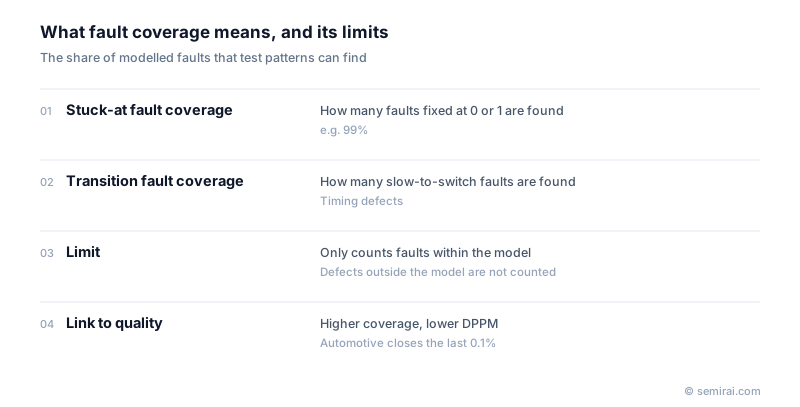
Coverage only counts what the model contains
Coverage is always relative to a fault model. Even 100% stuck-at coverage says nothing about defects that only cause delays, or about small leakage paths. In practice, teams track coverage for several models, such as stuck-at, transition and bridging faults, and add other methods such as IDDQ (quiescent supply current) testing and system level test (SLT) to catch what the models miss.
Some faults are untestable: the circuit structure makes them impossible to control or observe from outside. Reducing them requires design changes, such as adding test points, rather than more patterns.
Coverage, quality and cost
Defects that tests miss escape to customers and show up as DPPM (defective parts per million). Classic models of defect level show that, at high coverage, the escape rate falls roughly in proportion to the coverage that is still missing, so moving from 99% to 99.9% cuts escapes by about an order of magnitude. That is why automotive suppliers, who need very low DPPM, invest in closing the last fraction of a percent.
Higher coverage has a price: more patterns and longer test time, and more DFT logic, which costs area and power. How far to go depends on the quality the product requires and the test cost it can bear.
Japanese companies involved
- Coverage targets translate directly into tester time on automatic test equipment, such as Advantest's SoC testers, which is a large part of the cost of testing a chip.
- Advantest · Automated test equipment (ATE) for SoC and memory
FAQ
Who calculates fault coverage?
ATPG and fault simulation tools calculate it during design. If the target is not met, engineers add DFT structures or test points and rerun the analysis. Coverage is a design review item, and missing the target can delay tape-out.
Is test coverage the same as fault coverage?
They are often used interchangeably. Some tools define test coverage with untestable faults removed from the total, so it reads higher than fault coverage calculated over all faults. It is worth checking which definition a report uses.
Related pages
- ATPG (Automatic Test Pattern Generation)
- Design for Testability (DFT)
- DPPM (Defective Parts Per Million)
- Built-In Self-Test (BIST)
- System Level Test (SLT)
- Silent Data Corruption (SDC)
- EDA (Electronic Design Automation)
- Test Vector / Test Pattern
- Final test equipment
- Advantest 7038 System-Level Test System
- Advantest T2000
- DISCO DIS100
- Tokyo Electron (TEL) Prexa™ SDP
Sources
Last updated: November 2, 2026