Skin Effect
The skin effect is the tendency of alternating current in a conductor to flow mainly near the surface, leaving the centre nearly unused, as frequency increases. Changing current induces eddy currents inside the conductor that oppose current at the centre. The effective cross-section shrinks, so resistance and signal loss rise with frequency.
Also called: skin depth
Diagram
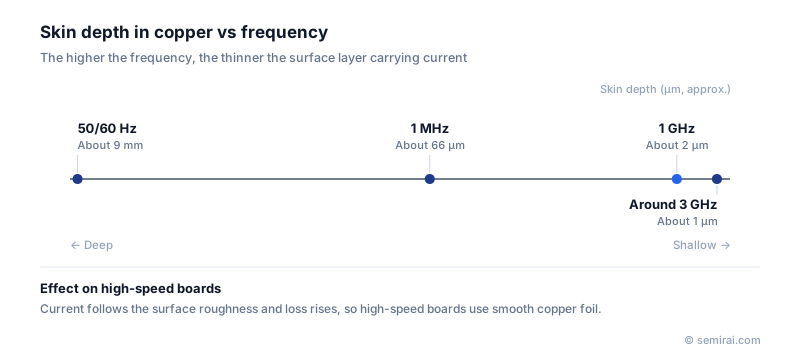
Skin depth
The depth within which most of the current flows is called the skin depth, δ = √(2ρ/ωμ), where ρ is resistivity, ω the angular frequency and μ the permeability. Skin depth falls with the square root of frequency.
In copper it is about 9 mm at mains frequencies of 50 to 60 Hz, about 66 µm at 1 MHz, about 2 µm at 1 GHz and about 0.7 µm at 10 GHz. At gigahertz frequencies, signals travel in only a very thin layer at the surface of a trace.
Why it matters in electronics
On package substrates and printed circuit boards, the skin effect increases loss for high-speed signals, which weakens them and blurs the edges of their waveforms. Because current flows in such a thin layer, the roughness of copper foil matters: current follows the bumps and travels further. Boards for high-speed communication therefore use smooth, low-profile copper foil.
High-frequency inductors use litz wire, made of many thin insulated strands, or plate the surface with a more conductive metal. In semiconductor equipment, the paths that deliver radio-frequency (RF) power to plasma chambers are also designed with skin depth in mind.
Japanese companies involved
- Murata Manufacturing makes chip inductors, capacitors and RF modules, components whose high-frequency losses depend on effects such as this.
- Murata Manufacturing · Capacitors, RF modules, SAW/BAW filters and MEMS sensors
FAQ
Does making a wire thicker reduce high-frequency resistance?
Only up to a point. Once the wire is much thicker than the skin depth, extra thickness carries little current. Increasing surface area, for example with flat conductors, hollow tubes or litz wire, is more effective than adding material at the centre.
Why is surface plating used in RF parts?
Since high-frequency current flows only in a thin surface layer, coating a part with a few micrometres of a good conductor such as silver or copper gives most of the benefit of making the whole part from that metal. It also protects the surface from oxidation that would raise loss.
Related pages
Sources
Last updated: November 1, 2026