ASIC (Application-Specific Integrated Circuit)
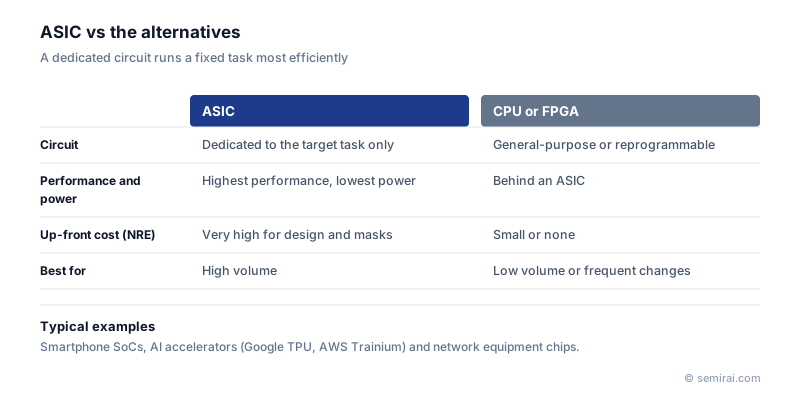
An ASIC (application-specific integrated circuit) is an integrated circuit designed and manufactured for one particular application rather than general use. Because the circuit implements only the required function, it can outperform general-purpose CPUs and FPGAs in speed, power consumption and chip area for that task.
Also called: application-specific IC, custom chip, custom silicon
Diagram
How an ASIC is designed
Design starts with a register-transfer level (RTL) description of the logic. Logic synthesis turns it into a netlist of standard cells, place-and-route lays out the cells and wiring, and design rule check (DRC) and layout-versus-schematic (LVS) verification confirm that the layout can be manufactured and matches the circuit. The result is a GDSII or OASIS file that is sent to the foundry for mask making, the step called tape-out.
Every stage relies on electronic design automation (EDA) software from vendors such as Synopsys, Cadence and Siemens EDA. At advanced nodes the one-time engineering cost of design, verification and masks is very large.
ASIC vs FPGA
An FPGA is a chip whose logic can be reprogrammed after manufacture, so it needs no masks and can be changed at any time. An ASIC's circuit is fixed once made, but it is smaller, faster and uses less power. The deciding factor is volume: the non-recurring engineering (NRE) cost of an ASIC only pays back when many units are built, while FPGAs suit prototypes, low volumes and products whose function may change.
Smartphone application processors, AI accelerators such as Google's TPU and AWS Trainium, network switch chips and cryptocurrency mining chips are typical ASICs. Large cloud and device companies increasingly design their own ASICs and have them made by foundries.
Japanese companies involved
- Socionext is a fabless company that designs custom SoCs for customers in automotive, data centre and consumer applications and has them made by foundries.
- Socionext · Fabless custom SoC design
FAQ
Is a smartphone SoC an ASIC?
In the broad sense, yes. It is designed for one product family and combines CPU, GPU, neural processing, image processing and other blocks for that use. In industry usage, however, ASIC often refers more narrowly to custom chips built for a specific customer.
What is a structured or semi-custom ASIC?
It is a compromise in which most layers are pre-made and only a few metal layers are customised. This cuts mask cost and lead time compared with a full-custom ASIC, at the expense of some density and performance.
Why are ASICs used for AI?
AI workloads are dominated by a few operations, mainly large matrix multiplications. A chip built for those operations can deliver more computation per watt than a general-purpose processor, which matters when thousands of chips run in a data centre.
Comparisons
Related pages
Sources
Last updated: November 2, 2026