RF Generator
An RF generator is the power supply that delivers radio-frequency power to a process chamber to create and sustain plasma. It is used in plasma etch, PECVD, plasma ALD and sputtering, and the stability and speed of its output directly control plasma density and ion energy, and therefore process results.
Also called: RF power supply, radio-frequency generator
Diagram
Choosing frequencies
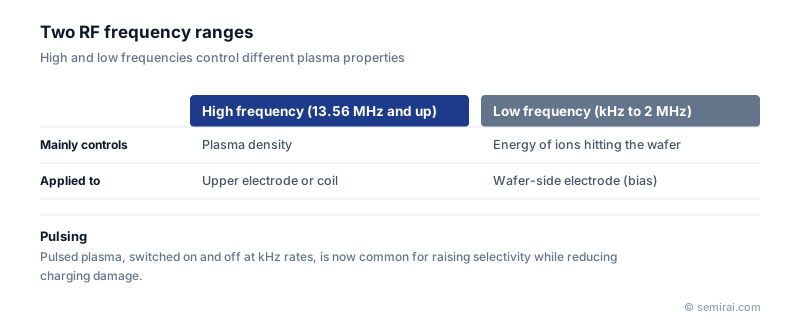
The basic frequency is 13.56 MHz, an industrial, scientific and medical (ISM) band. Higher frequencies such as 27, 60 or 100 MHz raise plasma density efficiently. Lower frequencies, from about 400 kHz to 2 MHz, are applied to the wafer electrode to set the energy of ions striking the wafer.
Capacitively coupled etch tools therefore use two or three generators at different frequencies, so density and ion energy can be adjusted separately. A matching network between each generator and the chamber transforms the plasma's changing impedance so that power is delivered rather than reflected.
Pulsing and control
Many current processes pulse the RF on and off at kHz rates instead of running continuously. Pulsing changes electron temperature and the balance of radicals and ions over time, which can improve selectivity, reduce charging damage and help profile control in high-aspect-ratio etch. Several generators can be pulsed in synchrony.
Plasma is a non-linear load: its impedance changes sharply at ignition and during pulses. The generator must detect reflected power, protect itself and settle quickly at the target power. Voltage and current probes at the generator and the match measure the power actually delivered, which helps keep chambers matched to each other.
Japanese companies involved
- Daihen makes RF power supplies and matching networks for semiconductor equipment.
- Kyosan Electric Manufacturing makes power supplies for semiconductor and flat panel display equipment.
- Daihen · RF power supplies, matching networks and wafer transfer robots
- Kyosan Electric Manufacturing · Power supplies for semiconductor and FPD equipment
FAQ
Why is 13.56 MHz used so widely?
It is an internationally allocated ISM frequency, so equipment can radiate small amounts of energy at it without interfering with licensed radio services. It also happens to be a practical frequency for sustaining plasma in chambers of wafer scale.
What does the matching network do?
The generator expects a fixed load, usually 50 ohms, while the plasma's impedance is different and changes. The matching network adjusts capacitors and inductors to transform the plasma load to 50 ohms, so most power goes into the plasma and little is reflected back.
Related pages
Sources
Last updated: November 12, 2026