Copper Interconnect (Damascene Process)
Copper interconnect is the use of copper (Cu) for the multilevel wiring of semiconductor chips. Copper has lower resistivity than aluminium and better resistance to electromigration, so it replaced aluminium in advanced logic from the late 1990s. Because copper cannot be dry-etched easily, it is patterned with the damascene process.
Also called: Cu interconnect, damascene, dual damascene
Diagram
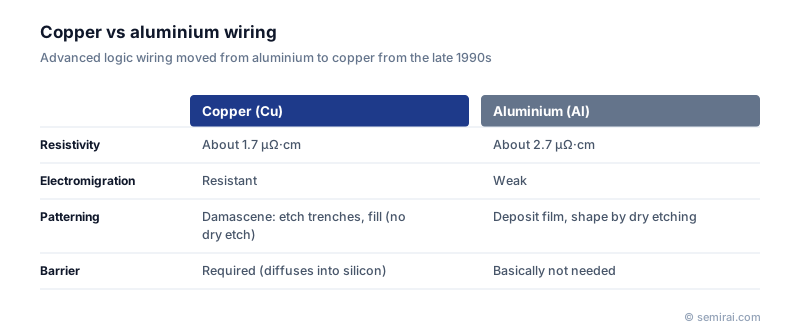
Why copper replaced aluminium
The bulk resistivity of copper is about 1.7 µΩ·cm, compared with about 2.7 µΩ·cm for aluminium. Lower resistance means less signal delay and less power lost in the wiring. Copper also resists electromigration, the gradual movement of metal atoms driven by current, much better than aluminium, which improves the lifetime of narrow lines. IBM announced the first copper process for chips in 1997.
How the damascene process works
Instead of depositing metal and etching it into lines, the damascene process etches trenches into the dielectric and fills them with metal. In single damascene, trenches and vias are formed in separate steps. In dual damascene, both the via holes and the line trenches are etched first and filled with copper in one go.
Copper diffuses into silicon and dielectrics, so a barrier of tantalum nitride and tantalum is deposited by PVD first, followed by a thin copper seed layer. Copper is then filled by electroplating. CMP removes the excess copper and barrier from the surface, and a dielectric cap such as SiCN or SiN is deposited on top to seal the copper. This sequence is repeated for every metal layer.
Limits at the smallest pitches
As lines shrink toward ten nanometres wide, the barrier takes up a growing share of the cross-section and electrons scatter more at surfaces and grain boundaries, so copper's effective resistance rises sharply. Chipmakers are therefore introducing cobalt, ruthenium or molybdenum in the narrowest layers, while copper with low-k dielectrics remains standard for the rest of the stack.
Japanese companies involved
- Ebara makes CMP systems used to polish back copper and barrier layers after plating.
- Ebara · CMP systems, dry vacuum pumps and exhaust treatment
FAQ
Why is it called damascene?
The name comes from a traditional metal inlay technique associated with Damascus, in which metal is set into grooves cut in a surface. The chip process works the same way: metal is inlaid into trenches and the surface is polished flat.
Why can't copper simply be etched like aluminium?
Copper does not form volatile compounds with common etch gases at practical temperatures, so plasma etching leaves residues instead of removing it cleanly. Damascene avoids the problem by never etching the copper itself.
Related pages
Sources
Last updated: November 2, 2026