Copper Clad Laminate (CCL)
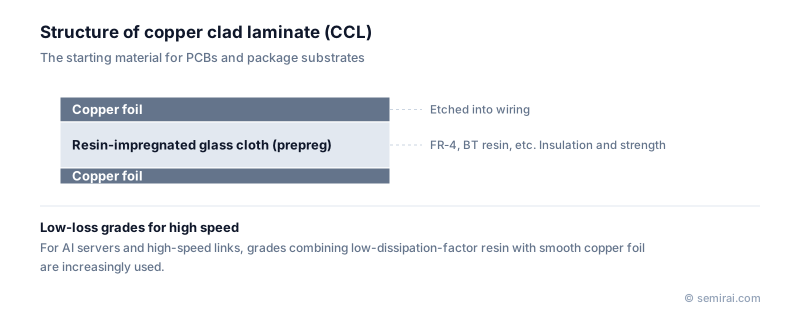
Copper clad laminate (CCL) is a sheet material made by bonding copper foil to one or both sides of an insulating board of glass-fibre cloth impregnated with resin. It is the starting material for printed circuit boards and semiconductor package substrates: the foil is etched into wiring and holes are drilled and plated to connect the layers.
Also called: copper-clad laminate, laminate
Diagram
What sets its properties
The resin system largely determines how a laminate behaves. The most common grade is FR-4, glass cloth with epoxy resin, used in most electronic equipment. Package substrate cores use materials with higher heat resistance and lower thermal expansion, such as BT resin, and fine wiring is then built up on them with insulating films such as ABF.
Key specifications are the glass transition temperature (Tg), at which the resin softens; the coefficient of thermal expansion; and two electrical properties, the dielectric constant (Dk) and the dissipation factor (Df), which govern how signals travel through the board.
Low-loss laminates for high-speed signals
At higher frequencies, more signal energy is lost in the resin (dielectric loss) and in the copper, where current crowds into the surface because of the skin effect (conductor loss). Laminates for AI servers, network switches and high-speed communications therefore combine resins with a very low dissipation factor and copper foils with a smoothed surface. Glass cloth with lower dielectric constant is also used. These materials are harder to process than FR-4 and cost more, so designers use them only on the layers that carry the fastest signals.
Japanese companies involved
- Mitsubishi Gas Chemical developed BT resin and supplies BT-based laminates widely used as package substrate cores.
- Resonac and Sumitomo Bakelite make copper clad laminates and prepregs, including low-loss grades for high-speed boards.
- Resonac · CMP slurries, packaging materials and SiC epitaxial wafers
- Mitsubishi Gas Chemical · High-purity hydrogen peroxide and cleaning chemicals
- Panasonic Connect · Plasma dicing, dry etching, plasma cleaning and flip chip bonding equipment
- Sumitomo Bakelite · Epoxy mold compounds and package materials
FAQ
What is the difference between CCL and a PCB?
CCL is a raw material: an insulating board with plain copper foil on its surface and no circuit pattern. A PCB is the finished board made from it by etching the copper into wiring, drilling and plating holes and, for multilayer boards, laminating several layers together.
What is prepreg and how does it relate to CCL?
Prepreg is glass cloth impregnated with partially cured resin. It acts as the bonding and insulating layer when inner cores are stacked into a multilayer board; under heat and pressure it flows and cures. CCL itself is made by laminating prepreg with copper foil.
Related pages
Sources
Last updated: November 13, 2026