Avalanche Breakdown
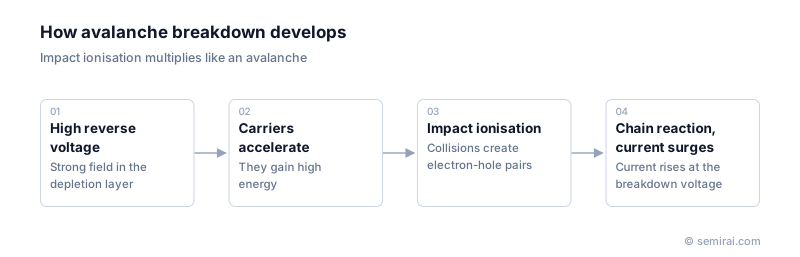
Avalanche breakdown occurs when a high reverse voltage across a pn junction accelerates electrons and holes in the depletion region so strongly that they knock new electron-hole pairs out of the lattice. The new carriers are accelerated in turn and create more, a chain reaction that makes current rise sharply. Creating carriers by collision is called impact ionisation.
Also called: avalanche multiplication, impact ionisation breakdown
Diagram
Breakdown voltage and materials
The voltage at which avalanche starts depends on the critical electric field the material can withstand and on the width of the depletion region. The breakdown voltage of most power semiconductors is set by avalanche breakdown.
Silicon has a critical field of about 0.3 MV/cm. SiC and GaN have roughly ten times as much, so they can block the same voltage with a drift layer about one tenth as thick. A thinner, more heavily doped drift layer has much lower resistance, which is why wide-bandgap power devices can achieve lower on-resistance at a given voltage rating.
Using and surviving avalanche
Avalanche multiplication is put to use in the avalanche photodiode (APD), which multiplies the few carriers generated by light so that weak signals can be detected.
In power circuits, switching off current through an inductive load such as a motor winding produces a voltage spike that can drive a transistor into avalanche. Devices must survive this without failing, and the energy they can absorb is specified as avalanche ruggedness.
Japanese companies involved
- ROHM makes SiC MOSFETs and Schottky diodes, power devices whose voltage ratings rely on the high critical field of silicon carbide.
- ROHM · SiC and silicon power devices, analog ICs
FAQ
How does avalanche breakdown relate to a power device's voltage rating?
The rated voltage is set just below the avalanche voltage. A thicker, more lightly doped drift layer raises it but also raises on-resistance, so designers trade one against the other. Materials with a higher critical field shift this trade-off in their favour.
What is avalanche energy on a data sheet?
It is the energy a power transistor can absorb in avalanche without damage, usually given in millijoules for a single pulse and sometimes for repeated pulses. It shows how well the device tolerates voltage spikes from inductive loads when no clamp circuit is fitted.
Related pages
- Zener Breakdown
- Breakdown Voltage
- Avalanche Capability (Avalanche Energy)
- Avalanche Photodiode (APD)
- PN Junction
- Wide Bandgap Semiconductor (WBG)
- Semiconductor materials (wafers and substrates)
- Shin-Etsu Chemical 300 mm silicon wafers
- SUMCO Polished wafers (PW)
- Sumitomo Electric Industries (compound semiconductors) GaAs and InP substrates
Sources
Last updated: November 12, 2026