Zener Diode
A Zener diode, also called a voltage regulator diode, is a diode designed to operate in reverse breakdown. When the reverse voltage reaches its Zener voltage, current rises sharply while the voltage across the diode stays nearly constant. It relies on two mechanisms, Zener breakdown and avalanche breakdown.
Also called: voltage regulator diode, constant-voltage diode
Diagram
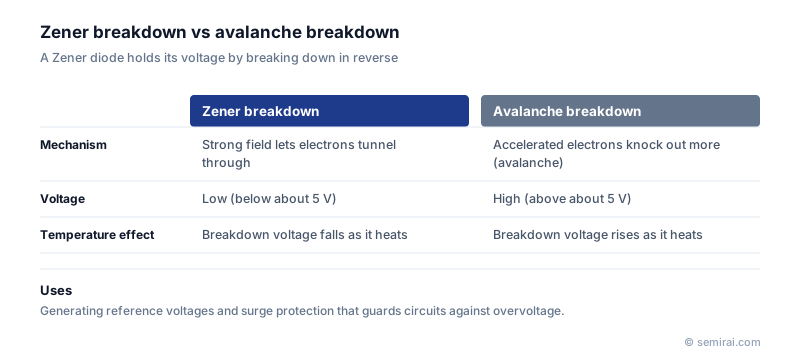
Two breakdown mechanisms
In Zener breakdown, the junction is heavily doped and very thin, so a strong electric field lets electrons tunnel directly from the valence band on the p side to the conduction band on the n side. This dominates in diodes with breakdown voltages below about 5 V. In avalanche breakdown, carriers accelerated by the field gain enough energy to knock out further electron-hole pairs, which then multiply. This dominates above about 5 V.
The two mechanisms respond to temperature in opposite directions. The Zener voltage falls as temperature rises, while the avalanche voltage rises. Near 5 to 6 V the two effects roughly cancel, so diodes in that range have the most stable voltage over temperature.
How Zener diodes are used
Unlike an ordinary diode, a Zener diode is not damaged by breakdown as long as its power rating is respected. The simplest use is a reference or regulator: a resistor in series with the supply limits the current, and the Zener holds the output at its breakdown voltage. More precise references in ICs use bandgap circuits, but discrete Zeners remain common because they are small, cheap and simple.
Zener diodes are also used to clamp overvoltage, for example to protect inputs against surges or electrostatic discharge. Dedicated transient voltage suppressor (TVS) diodes are built on the same avalanche principle but designed to absorb larger pulses.
Japanese companies involved
- ROHM and Toshiba Electronic Devices & Storage make Zener diodes and ESD protection diodes for consumer, industrial and automotive circuits.
- Toshiba Electronic Devices & Storage · Power MOSFETs, IGBTs and discrete semiconductors
- ROHM · SiC and silicon power devices, analog ICs
FAQ
Why is it called a Zener diode even above 5 V?
The name comes from Clarence Zener, who described the tunnelling breakdown. Diodes that operate by avalanche breakdown at higher voltages are still sold as Zener diodes because they are used in the same way.
What range of voltages is available?
Standard Zener diodes are offered from around 2 V up to a few hundred volts, in fine steps, so designers can pick the voltage they need. The power rating, set by the package, limits how much current they can carry.
Related pages
Sources
Last updated: November 2, 2026