Solar Cell (Photovoltaic Cell)
A solar cell is a semiconductor device in which light absorbed near a pn junction creates electrons and holes that the junction separates, producing a voltage and a current (the photovoltaic effect). It converts light directly into electricity with no fuel and no moving parts, and crystalline silicon is the main material in mass production.
Also called: photovoltaics, PV cell
Diagram
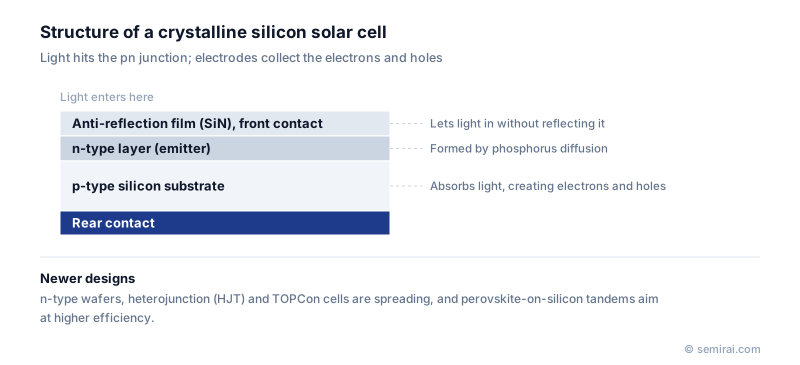
How a solar cell produces power
A typical crystalline silicon cell is a silicon wafer with a thin layer of opposite doping near the front surface. Photons with more energy than the bandgap create electron-hole pairs. The built-in electric field of the junction pushes electrons one way and holes the other, and metal contacts on the front and back collect them as current in an external circuit.
A single cell delivers only about 0.5 to 0.7 V, so dozens of cells are connected in series and parallel and laminated into a module, or panel, to reach a useful voltage and power. An anti-reflection coating, often silicon nitride, and a textured surface help the cell capture more of the incoming light.
Types of solar cells
Monocrystalline and multicrystalline silicon cells dominate the market. Newer silicon designs include cells on n-type wafers, TOPCon (tunnel oxide passivated contact) cells and heterojunction (HJT) cells that combine amorphous and crystalline silicon to reduce recombination at the surfaces.
Other approaches use compound semiconductors such as GaAs, which gives very high efficiency and is used in space, or thin films such as CIGS. Perovskite cells, which can be made from solution at low temperature, are under development both on their own and stacked on silicon as tandem cells to raise efficiency.
FAQ
How are solar cells related to semiconductor manufacturing?
Solar cells use many of the same steps as chipmaking: wafer slicing, dopant diffusion, thin film deposition, surface texturing and passivation, and metallisation. The tolerances are looser and the cost targets much lower, so the equipment is designed for very high throughput rather than nanometre precision.
What limits solar cell efficiency?
Photons with less energy than the bandgap are not absorbed, and photons with more energy lose the excess as heat. Carriers can also recombine before they reach the contacts, and some light is reflected or blocked by the front metal. Tandem cells address the bandgap limit by stacking materials with different bandgaps.
Related pages
Sources
Last updated: November 2, 2026