Zener Breakdown
Zener breakdown is the sudden rise in reverse current through a heavily doped pn junction when the strong field in its very thin depletion region lets valence-band electrons tunnel through the bandgap into the conduction band. It is named after Clarence Zener, who explained the mechanism theoretically in 1934, and is the basis of voltage-reference diodes.
Also called: Zener effect, tunnelling breakdown
Diagram
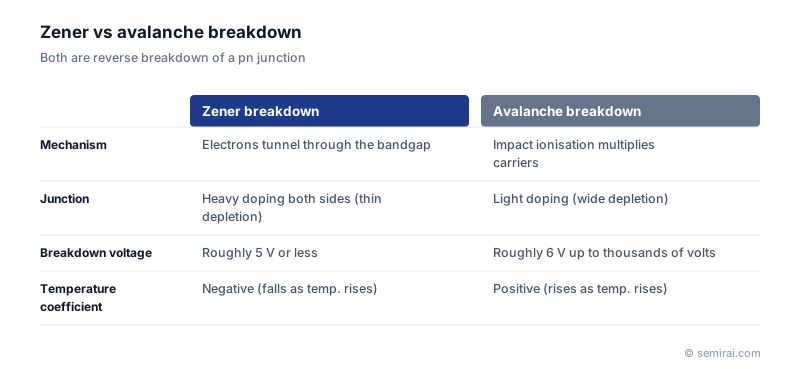
Zener vs avalanche breakdown
Zener breakdown occurs in junctions with heavy doping on both sides, generally at reverse voltages below about 5 V. At higher voltages, breakdown is mainly by avalanche multiplication, where accelerated carriers knock out new electron-hole pairs.
The two mechanisms respond to temperature in opposite ways. In Zener breakdown, the bandgap narrows as temperature rises, tunnelling becomes easier and the breakdown voltage falls, a negative temperature coefficient. In avalanche breakdown, stronger lattice vibrations make it harder for carriers to gain energy, so the breakdown voltage rises, a positive temperature coefficient.
Zener diodes
Breakdown does not by itself destroy the junction. If current is limited, the voltage across the diode stays almost constant while the current changes. Zener diodes, also called voltage-regulator diodes, use this to provide a reference voltage or to clamp voltage spikes.
Commercial Zener diodes include devices that actually break down by avalanche; the name covers both. Around 5 to 6 V the two temperature coefficients roughly cancel, so diodes in that range change voltage very little with temperature.
Japanese companies involved
- ROHM and Toshiba Electronic Devices & Storage both offer Zener diodes among their discrete semiconductors.
- Toshiba Electronic Devices & Storage · Power MOSFETs, IGBTs and discrete semiconductors
- ROHM · SiC and silicon power devices, analog ICs
FAQ
Does Zener breakdown damage the diode?
No. The breakdown itself is reversible, and the diode recovers once the voltage falls. Damage comes from heat if current is not limited, so a Zener diode is used with a series resistor or another current limit that keeps power dissipation within its rating.
Why does heavy doping lead to tunnelling?
Heavy doping on both sides makes the depletion region only a few nanometres wide. The bands then bend so steeply that the filled valence band on one side lines up with empty conduction band states on the other across a very short distance, and electrons can tunnel through.
Related pages
Sources
Last updated: November 12, 2026