THB Test (Temperature Humidity Bias)
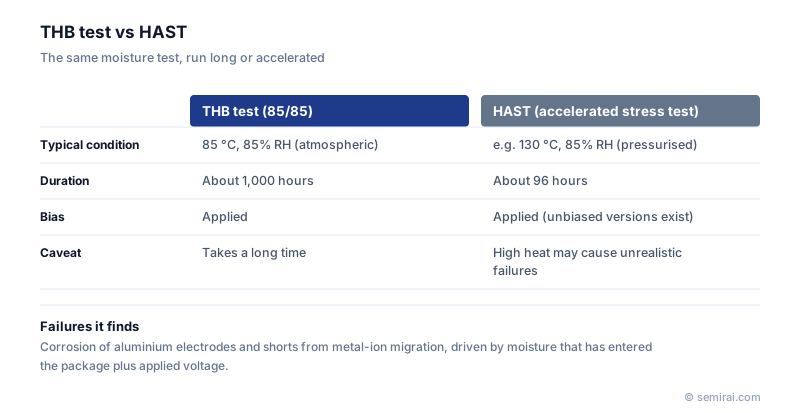
The THB (temperature humidity bias) test is a reliability test that checks a semiconductor package's resistance to moisture by keeping it at high temperature and humidity with voltage applied for a long time. The standard condition is 85 °C and 85% relative humidity, the so-called 85/85 test, typically for 1,000 hours. JEDEC JESD22-A101 defines the method.
Also called: 85/85 test, temperature humidity bias life test
Diagram
What it looks for
Plastic mould compounds let small amounts of water through, so after long exposure to humid air moisture reaches the chip surface. With voltage present, aluminium bond pads and lines can corrode electrochemically, and metal ions can be drawn by the electric field to form a conductive path to a neighbouring conductor, a process called ion migration.
THB reproduces these moisture-plus-bias failures under conditions harsher than normal use, so that a weakness in the passivation, the mould compound or the package interfaces shows up within the test period.
THB and HAST
Because 1,000 hours is a long time, HAST (highly accelerated stress test) is widely used instead. HAST raises temperature and pressure, for example 130 °C at 85% relative humidity, and finishes in about 96 hours. It produces the same types of failure much faster.
The higher temperature can, however, trigger mechanisms that would never occur in the field, such as degradation of some mould compounds, so engineers choose between THB and HAST according to the materials and the purpose. There are also unbiased versions that check the effect of moisture alone.
Japanese companies involved
- ESPEC makes temperature and humidity chambers and HAST pressure chambers used to run THB and HAST tests on packaged devices.
- ESPEC · Environmental and reliability test chambers
FAQ
How do THB and HAST differ?
Both expose biased parts to heat and humidity. THB runs at atmospheric pressure at 85 °C and 85% RH for about 1,000 hours. HAST uses a pressurised chamber at around 130 °C and 85% RH and takes about 96 hours. HAST is far quicker but carries more risk of unrealistic failure modes.
Why is voltage applied during the test?
Most moisture-related failures need both water and an electric field. The voltage drives electrochemical corrosion of metal and pulls metal ions between conductors. Testing without bias would miss these mechanisms, so the bias is chosen to keep leakage and self-heating low while keeping the field present.
Related pages
Sources
Last updated: November 1, 2026