Time-Dependent Dielectric Breakdown (TDDB)
Time-dependent dielectric breakdown (TDDB) is a reliability failure in which a gate dielectric, such as silicon oxide or a high-k film, held under a constant electric field suddenly loses its insulating properties after some time. It is one of the main mechanisms that limit transistor lifetime, and it becomes harder to control as gate dielectrics get thinner.
Also called: TDDB, oxide breakdown
Diagram
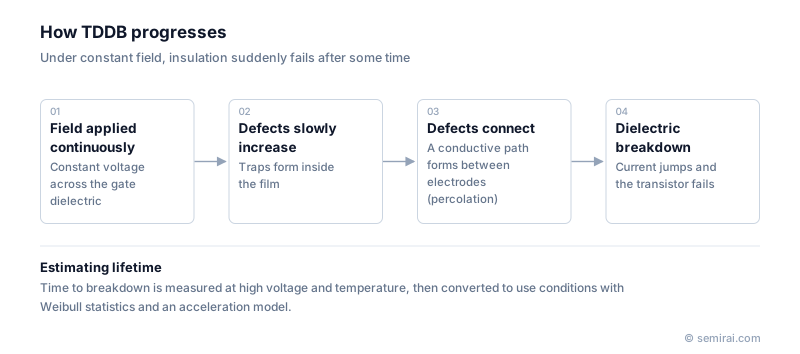
How breakdown develops
The widely used model is percolation. Electrical stress slowly creates defects, called traps, inside the dielectric. They appear at random places, and nothing dramatic happens while they are isolated. When enough traps line up to form a continuous conductive path between the gate and the channel, current flows through the film and breakdown occurs.
Breakdown comes in two forms. In soft breakdown the leakage current rises gradually and the transistor may still work, with degraded characteristics. In hard breakdown the insulation is lost abruptly and the device fails.
Why scaling makes TDDB harder
As the equivalent oxide thickness (EOT) shrinks, the same voltage produces a stronger field across the dielectric and lifetime falls. High-k dielectrics with metal gates were introduced partly for this reason: a hafnium-based film can be physically thicker than silicon dioxide for the same capacitance, which reduces leakage and helps reliability.
Time to breakdown varies widely from device to device, so lifetimes are analysed statistically, usually with the Weibull distribution. TDDB sits alongside negative bias temperature instability (NBTI) and hot-carrier injection (HCI) as one of the main front-end wear-out mechanisms considered when a process is qualified.
FAQ
How is TDDB measured?
Test structures are stressed at voltages and temperatures above normal operation and the time to breakdown is recorded for many samples. The distribution is fitted with Weibull statistics and extrapolated to use conditions. Because a larger gate area is more likely to contain a weak spot, the area dependence is also taken into account. JEDEC JESD92 describes such a procedure.
How is TDDB prevented?
By keeping the field low and the film clean: using high-k dielectrics that allow a thicker physical film, limiting operating voltage, improving deposition to reduce defects in the film, and avoiding plasma charging damage during processing.
Does TDDB affect only gate oxides?
The term usually refers to gate dielectrics, but a similar time-dependent breakdown also occurs in the low-k dielectrics between closely spaced copper interconnects, where it is a growing concern at fine pitches.
Related pages
Sources
Last updated: November 1, 2026