Automated Test Equipment (ATE)
Automated test equipment (ATE) is a computer-controlled system that tests the electrical function and performance of semiconductor chips. It applies power and test patterns to the device under test (DUT), measures the outputs, compares them with expected values and decides whether each chip passes and into which bin it goes.
Also called: ATE, semiconductor tester, IC tester
Diagram
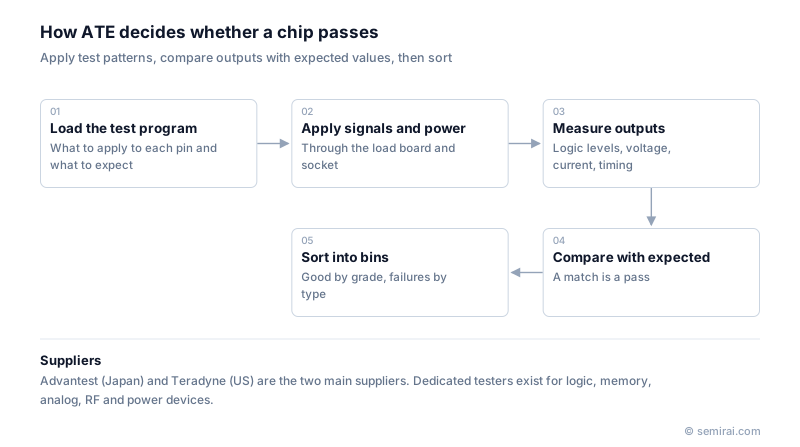
How an ATE system works
A tester has a mainframe with power supplies and control computers, and a test head that sits close to the device. In the test head, pin electronics drive each signal pin with precise voltages and timing and compare the response on every clock edge. Device power supplies, precision measurement units and, for mixed-signal and RF parts, waveform sources and digitisers complete the set.
The tester never touches the chip directly. At wafer test it is docked to a wafer prober, which moves the wafer and connects the dies through a probe card. At final test it is docked to a test handler, which presses packaged chips into test sockets. A load board or probe interface board routes the tester channels to the device pins.
A test program written by test engineers defines which patterns to apply, what to measure and the limits, and the results are logged per die for yield analysis.
Types of testers
Testers are specialised by device type. SoC and logic testers emphasise many high-speed digital channels and scan test. Memory testers apply long algorithmic patterns to large numbers of devices in parallel. Analog and mixed-signal testers focus on precise voltages, currents and converters, RF testers on frequency and power, and power device testers on high voltages and currents.
Keeping test cost down
A tester is expensive and test time adds directly to chip cost, so engineers test many devices at once (multi-site testing), use design-for-test features such as scan compression and built-in self-test to shorten patterns, and use adaptive test to skip items that rarely fail. Large AI processors and stacked memory raise the difficulty: more pins, higher data rates, high power draw and the need to screen known good dies before stacking.
Japanese companies involved
- Advantest is one of the two largest ATE makers, alongside Teradyne of the United States, and supplies SoC and memory testers as well as test handlers.
- Advantest · Automated test equipment (ATE) for SoC and memory
FAQ
What does an ATE test actually check?
Typical checks are continuity of every pin, leakage and supply currents (DC tests), functional patterns that exercise the logic or memory cells, speed and timing at the rated frequency, and analog parameters where relevant. The order is chosen so that gross failures stop the test early and save time.
Is ATE the same as system-level test?
No. ATE drives the pins with structured patterns. System-level test places the chip on a board that resembles the final product and runs real software, catching failures that structural patterns miss. Many processors go through both.
Who writes the test program?
Product and test engineers at the chip company or its test subcontractor write it from the design's test patterns and specifications, then tune limits and test order with data from production.
Related pages
Sources
Last updated: November 12, 2026