Tin Whisker
Tin whiskers are thin, needle-like crystals that grow spontaneously over time from the surface of tin plating on component terminals. They are a few micrometres thick but can reach hundreds of micrometres or even millimetres in length. When a whisker touches a neighbouring terminal, it causes an electrical short.
Also called: whisker, Sn whisker
Diagram
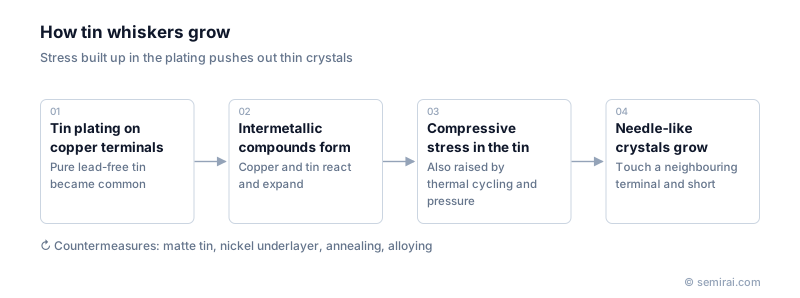
Why whiskers grow
The main driver is compressive stress built up in the tin film. When tin is plated onto copper terminals, copper and tin react at the interface to form intermetallic compounds. Their growth expands the volume and squeezes the tin layer, and tin atoms with nowhere else to go are pushed out through weak spots in the surface oxide, forming a whisker.
Temperature cycling, external mechanical pressure such as from connectors, and humidity with corrosion also promote whisker growth. Growth can take months to years, and the rate varies widely with conditions.
The lead-free problem and countermeasures
Tin-lead solder and plating largely suppressed whiskers. When environmental rules such as the EU RoHS directive restricted lead, pure tin finishes spread and whiskers became a major problem again.
Countermeasures include matte tin plating with coarser grains, a nickel barrier layer between copper and tin to slow the intermetallic reaction, annealing after plating to relieve stress, and adding small amounts of other elements such as bismuth to the tin. JEDEC and other bodies define test methods and acceptance criteria for whiskers.
Japanese companies involved
- Mitsui High-tec makes lead frames, whose external leads are commonly finished with tin-based plating where whisker control applies.
- Senju Metal Industry makes lead-free solder alloys and related materials used in the move away from tin-lead.
- Mitsui High-tec · Lead frames
- Senju Metal Industry · Solder, flux and solder balls
FAQ
Why did lead-free soldering bring whiskers back?
Lead alloyed with tin changes the tin's grain structure and lets stress relax, so tin-lead finishes rarely grew whiskers. Once lead was restricted, pure tin and high-tin finishes became common, and these are far more prone to whiskers, especially on copper.
Which products are most at risk from whiskers?
Long-life, high-reliability equipment with fine-pitch terminals, such as aerospace, medical and some automotive and industrial systems. A whisker needs time to grow and a short gap to bridge, so products used for many years with tightly spaced leads face the highest risk. Some of these sectors still allow or require tin-lead finishes.
Related pages
Sources
Last updated: November 12, 2026