Zero Defect (ZD)
Zero defect (ZD) is a quality philosophy that sets the goal of no defective products, instead of accepting that some failures are inevitable, and builds quality into every stage from design to manufacturing and test. It was proposed in the United States in the 1960s and spread to Japan as the ZD movement in manufacturing.
Also called: zero defects, ZD
Diagram
Why automotive drives it
In semiconductors the idea matters most for automotive products. A modern car contains thousands of chips, and a single failure can disable the vehicle, cause an accident or trigger a recall. Cars also operate for many years in harsh heat, cold and vibration.
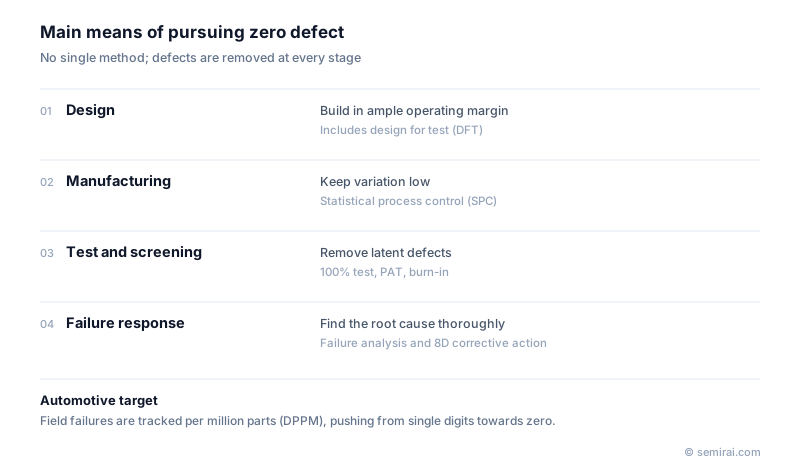
Suppliers therefore track field failures in defective parts per million (DPPM) and work to push the figure from single digits towards zero. Automotive customers expect this target to be part of the supplier's quality system, not a slogan.
How it is pursued
No single method achieves it. Designs include ample operating margin and design-for-test (DFT) features. Manufacturing variation is held down with statistical process control (SPC). Every part is tested, and part average testing (PAT) removes chips whose results are statistical outliers even when they are inside the limits. Burn-in and other stress screens remove early failures.
When a defect does reach a customer, the supplier performs a thorough root-cause analysis and corrective action, often documented in the 8D format. Literal zero is rarely reached, but removing the cause of each failure one by one keeps moving the rate towards it.
Japanese companies involved
- Renesas Electronics supplies microcontrollers and SoCs for vehicles, a product area where automotive quality programmes target zero defects.
- Renesas Electronics · Microcontrollers, automotive SoCs, analog and power chips
FAQ
Why is zero defect stressed for automotive semiconductors?
Because the consequences of a failure are severe and the volume of chips per car is large. Even a rate that would be acceptable in consumer electronics can mean many failing vehicles. Long service life and harsh conditions add to the risk, so automotive targets are far stricter.
What is part average testing (PAT)?
PAT sets limits based on the distribution of results from the population itself and removes parts that sit far from the norm, even though they pass the datasheet limits. The reasoning is that outliers are more likely to contain latent defects. Static PAT uses limits from earlier lots; dynamic PAT recalculates them per wafer or lot.
Related pages
Sources
Last updated: November 1, 2026