Kirkendall Void
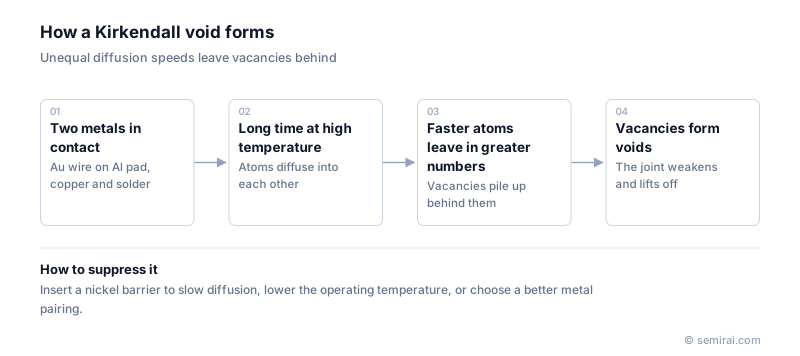
A Kirkendall void is a microscopic cavity that forms near the interface between two different metals because their atoms diffuse at different speeds. Vacancies pile up on the side that loses atoms faster and merge into voids. In packages they appear in gold-aluminium wire bonds and copper-solder joints after long exposure to high temperature.
Also called: Kirkendall voiding, Kirkendall effect
Diagram
Where the name comes from
In 1947 Ernest Kirkendall and colleagues showed that markers placed at a copper-brass interface moved during diffusion, proving that zinc and copper atoms diffuse at different rates. This is the Kirkendall effect. When one species leaves faster than the other arrives, the empty lattice sites it leaves behind accumulate and can condense into visible voids. Higher temperatures and longer times make them larger and more numerous.
Voids in wire bonds
When a gold wire is bonded to an aluminium pad, the two metals interdiffuse at high temperature and form intermetallic compounds. Kirkendall voids grow near the interface as this happens. Once the voids link up, bond strength falls and resistance rises until the bond lifts off. Some gold-aluminium compounds are purple, so this failure was historically called purple plague.
With copper wire on aluminium pads, intermetallic growth is slower, which is considered an advantage for high-temperature reliability.
Voids in solder joints
Between copper pads and tin-based solder, the intermetallics Cu₆Sn₅ and Cu₃Sn form. During long high-temperature storage, voids appear within the Cu₃Sn layer and at its interface. A line of such voids makes the joint brittle under drop and shock loads. Nickel plating on the copper is a common barrier that slows copper-tin diffusion; solder composition and pad surface finish are also tuned. Voiding is evaluated by high-temperature storage tests followed by wire pull or ball shear tests and cross-section analysis.
Japanese companies involved
- Nippon Micrometal produces gold and copper bonding wire, whose material choice affects how fast intermetallics and voids grow at the bond.
- ESPEC builds environmental test chambers used for the high-temperature storage tests that reveal Kirkendall voiding.
- Nippon Micrometal · Bonding wire and micro balls
- ESPEC · Environmental and reliability test chambers
FAQ
Are Kirkendall voids the same as solder voids?
No. Ordinary solder voids are gas bubbles trapped during reflow and are present from the start. Kirkendall voids form later, in the solid state, as atoms diffuse during service or ageing, and they sit in or next to the intermetallic layer.
Can lowering the operating temperature help?
Yes. Diffusion slows sharply as temperature falls, so keeping joints cooler delays void growth. In practice this is combined with diffusion barriers and suitable metal pairings rather than relied on alone.
Related pages
Sources
Last updated: November 2, 2026