Acceleration Model / Arrhenius Equation
An acceleration model is a formula that converts the results of short tests under harsh conditions, such as high temperature or voltage, into lifetime under real operating conditions. No one can wait ten years to prove a chip lasts ten years, so every reliability qualification depends on some acceleration model.
Also called: Arrhenius model, acceleration factor, Peck model, Coffin-Manson model
Diagram
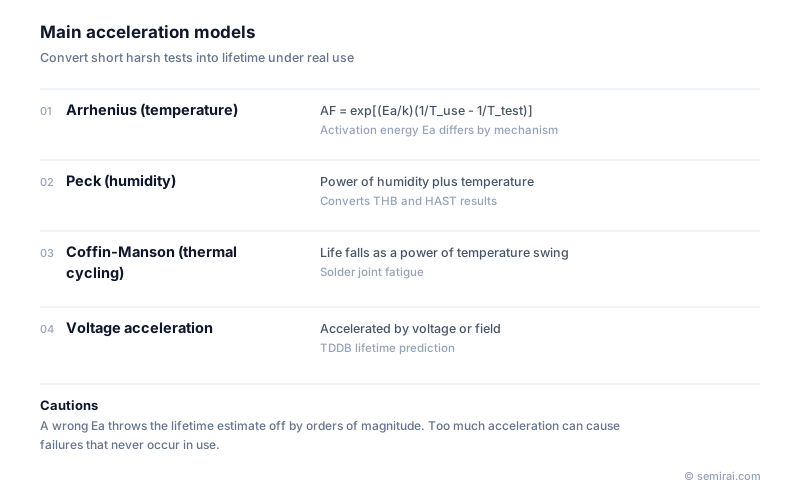
The Arrhenius equation
The most basic model is the Arrhenius equation, which says that the rate of a degradation reaction rises exponentially with temperature. The acceleration factor depends on the activation energy Ea, Boltzmann's constant and the difference between the inverse of the use and test temperatures, in kelvin. The higher the activation energy, the more strongly temperature accelerates the mechanism.
As an example, for a mechanism with Ea = 0.7 eV, 1,000 hours at 125°C is equivalent to several tens of thousands of hours at 55°C. Activation energy differs from one mechanism to another, and TDDB, NBTI and electromigration each have their own value. Using the wrong one can shift the lifetime estimate by orders of magnitude, so engineers first decide which mechanism they want to evaluate and then choose the test conditions.
Other stresses and the limits of acceleration
Other stresses have their own models. Voltage acceleration of dielectric breakdown is described with field-based models such as the E model and the 1/E model. Humidity-driven corrosion is modelled with Peck's law, which combines a power of relative humidity with an Arrhenius temperature term, and HAST results are converted with it. Fatigue from temperature cycling, for example of solder joints, follows the Coffin-Manson law, in which life falls as a power of the temperature swing.
Acceleration has limits. If conditions are too harsh, a different mechanism that never occurs in real use may dominate, and the conversion becomes meaningless. Test conditions must stay within the range where the same mechanism remains dominant, and judging that range is at the heart of reliability engineering.
Japanese companies involved
- ESPEC makes the temperature, humidity and thermal cycling chambers in which accelerated tests based on these models are run.
- ESPEC · Environmental and reliability test chambers
FAQ
Where do activation energy values come from?
From experiments that run the same test at several temperatures and fit the change in failure time, and from published references. JEDEC JEP122 collects failure mechanisms and the models and typical parameters used for them.
Can temperature and voltage acceleration be combined?
Yes. Many life tests raise both, and the total acceleration factor is the product of the thermal and voltage factors, as long as the same mechanism still dominates under the combined stress.
Related pages
- HTOL (High Temperature Operating Life)
- Bathtub Curve / FIT Rate
- HAST (Highly Accelerated Stress Test)
- Temperature Cycle Test (TCT)
- Time-Dependent Dielectric Breakdown (TDDB)
- Electromigration (EM)
- Rate-Limiting Step
- Weibull Distribution
- Final test equipment
- Advantest 7038 System-Level Test System
- Advantest T2000
- DISCO DIS100
- Tokyo Electron (TEL) Prexa™ SDP
Sources
Last updated: November 2, 2026